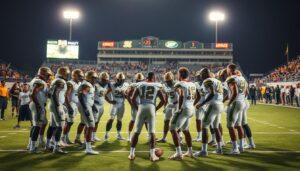
Welcome to the intellectual war room. Forget the generic pre-game fluff.
We’re diving deep into Canes football with surgical precision and late-night humor. It’s not just about who wins. It’s about how The U performs under pressure.
Our analysis is sharp, thanks to a recent win. It’s like a “Good, Bad, Ugly” review that’s too detailed for film critics. We’ve seen Carson Beck’s cool play and Rueben Bain’s game-changing skills.
Now, Miami is ranked #13 and facing the playoffs. The pressure is intense.
So, what makes this team’s success feel unique? Is it the mix of advanced stats and a team that believes in itself?
This preview is your chance to find out. Get ready.
Hurricane Season Update & Momentum
After a clean win, Miami’s momentum is clear. But what’s the metal it’s made of? The starters were like a master watchmaker, with five possessions leading to five touchdowns. This isn’t just winning; it’s a flawless statement.
Beating Bethune-Cookman is expected. But the real test is if this momentum is deep or just surface-level. Is it a one-time show of brilliance, or a sign of a strong defensive identity?
The playoff committee ranked The U #13. Congratulations, you’re now under intense pressure. Their ranking is a warning: no room for error. Every play is a chance to prove yourself.
A blowout win can feel like aluminum—light and flashy. But the ACC gauntlet demands titanium. It’s not about scoring; it’s about maintaining a high standard, even when starters rest.
The team might be creating something special. Their efficiency was not frantic but purposeful. This is the difference between being at the mercy of the elements and commanding them.
This success is not just about the game. It’s also a powerful tool for recruiting. Programs are using this momentum to attract top talent, turning each game into a sales pitch.
The Hurricane season update is positive. The engine is running smoothly, and the team is focused on the playoffs. But the real challenge is ahead. The momentum is real. Now, we see if it lasts.
Quarterback Battle & Passing Game Analysis
The most watched job in Miami this fall is the quarterback. Carson Beck is not just playing quarterback. He’s leading a symphony of short and intermediate passes with precision.
His game against Bethune-Cookman was a statistical masterpiece. He completed his first 15 consecutive passes. He finished 22 of 24 for 226 yards and two scores, with a completion percentage of 91.7%. For the season, he’s at 77.8%.
This kind of efficiency is key for any serious ACC game breakdown. But, is this success sustainable, or just a soft start?
The numbers show Beck’s near-flawless execution. Let’s look at his early-season performance.
| Statistic | Figure | The Context |
|---|---|---|
| Completion % (vs. Bethune-Cookman) | 91.7% | Near-perfect game management; 2 incompletions. |
| Consecutive Completions to Start | 15 | Program record; sets a tone of ruthless efficiency. |
| Season Completion Percentage | 77.8% | Elite territory; minimizes drive-killing mistakes. |
| Different Receivers Targeted | 14 | Democratic distribution; a defensive coordinator’s nightmare. |
Spreading the ball to 14 different receivers is a smart move. It keeps defenses guessing. It also shows Beck is making quick, correct reads.
But does the system challenge him enough? There are mentions of “play-calling errors” that suggest a limit to his abilities.
Is Beck a game manager or a chess master waiting for the right moment? The true ACC game breakdown will come when he faces a tough secondary. Can he make game-winning drives against top teams?
Right now, Beck is playing at a high level. The coming weeks will show if he’s ready for the ACC’s best. This quarterback battle is not just about arm talent; it’s about quick thinking under pressure.
Rushing Attack vs Opponent Run Defense
Mario Cristobal’s team isn’t just about running the ball. They aim to make a strong statement, one carry at a time. Against Bethune-Cookman, they made a bold statement. They ran for 199 yards, showing their dominance.
The Canes had nine big runs, over 10 yards each. These plays were like sudden surprises in the game. A 30-yard touchdown run by true freshman Girard Pringle Jr. was a highlight. It showed the team’s speed and versatility.
Now, let’s look at the other side. The Miami defense has been impressive, holding opponents under 100 yards rushing for two games. This is more than just a statistic. It’s a statement of their defensive strength.
“That’s the blueprint,” the team’s mantra is. The question is, can their offense match this defense’s toughness?
| Metric | Miami Offense (vs. Bethune-Cookman) | Miami Defense (Season Blueprint) |
|---|---|---|
| Rushing Yards | 199 | |
| Explosive Runs (10+ yds) | 9 | Goal: Minimize |
| Primary Weapon | Multi-Back Committee | Front Seven Discipline |
Practice is a battle between the offense and defense. The offense has a mix of power and speed. The defense is disciplined and strong. This season’s battles will be legendary.
Will the offense’s power win out? Or will the defense’s strength prevail? The answer is adaptability. A team needs to adjust when plans don’t work. The emergence of Pringle suggests they have the tools.
This clash is not just about strength. It’s about football smarts. For a real miami hurricanes preview, watch the line of scrimmage. That’s where the season’s story will unfold.
Defensive Line Pressure & Secondary Coverage
Ten tackles for loss and a diving interception are nice headlines. But the real story of The U’s defense is in the milliseconds. This the u football analysis isn’t about counting sacks; it’s about measuring chaos.
The Bethune-Cookman stat sheet sings a siren song of dominance. It shows 3.9 yards allowed per play and 10 tackles for loss. Bryce Fitzgerald’s acrobatic pick is a highlight. Rueben Bain Jr.’s strip-sack wasn’t just a play; it was a manifesto.
Coach Lance Guidry calls them a “fast, physical group… that relentlessly pursues the ball.” This feels like a brand identity. But Bain represents something more. He’s not a stat compiler; he’s a defensive seismic event.
His pressure creates fumbles, errant throws, and pure, unadulterated disorder. This is where the rubber meets the road for any serious the u football analysis.
A great pass rush and tight coverage share a symbiotic relationship. One makes the other exponentially more dangerous. The question isn’t *if* pressure is coming, but *how fast*.
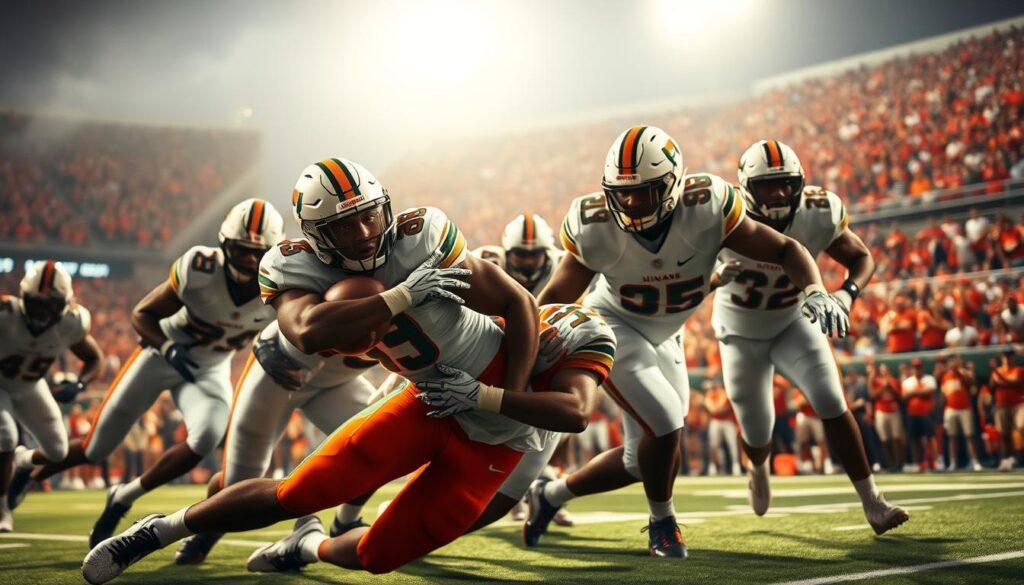
Is the front four getting home in 2.3 seconds or 3.5? That one-second gap is the difference between a coverage sack and a quarterback stepping into a throw. Are the corners playing press-man, trusting their athletes to disrupt routes and funnel everything inside? Or is it a zone scheme designed to bait quarterbacks into throwing to “windows” that slam shut?
The “better angles” Guidry mentioned post-game are key. Fitzgerald’s interception is a textbook example. Coverage forces a quarterback to hold the ball a tick longer, then a DB breaks on a route from a superior angle. It’s football geometry with a side of violence.
So, the million-dollar question: Is this a *truly elite* unit, or is it simply feasting on inferior competition? The upcoming test against a savvy [Opponent] quarterback will provide the answer. Against a polished passer, the margin between a game-winning turnover and a back-breaking completion is thinner than a South Beach cocktail napkin.
The identity is set—fast and physical. The production is undeniable. Now, the final piece of this defensive puzzle is proving the pass rush and secondary can operate in perfect, synchronized harmony against a legitimate threat. That’s the hallmark of a championship-caliber defense.
Transfer Portal Impact Players
CJ Daniels is more than just a new player; he’s a big statement. Miami worked hard to get him, showing their commitment. “it’s easy to see why Mario Cristobal chased after Daniels in the portal multiple times.”
Daniels is a key player who can change the game. He makes Miami’s passing game more exciting. His value will be seen in big plays and scoring chances.
The success of the transfer class depends on how well they work together. We need to see if they fill gaps or create new opportunities. This requires a close look at the team’s roster.
The value of these players is clear. It’s not just about money. It’s about winning games, getting first downs, and scoring touchdowns. Does the new linebacker make a difference right away? Does the new lineman start from day one?
This is the story of modern college football. Teams expect to see results right away. There’s no time to adjust in the ACC. These players are expected to perform now.
Understanding this is key for any ACC game breakdown. Teams face different challenges when they have players from other schools. For a full look at where every Miami Hurricane transfer landed, the team’s plan is clear. This transfer class is about moving forward faster, changing every ACC game breakdown from now on.
Coaching Staff Game Planning Tendencies
An ‘A-‘ grade for coaching sounds impressive, but play-calling errors can cost a championship. In this miami hurricanes preview, we explore the impact of Mario Cristobal’s staff on game plans.
The ‘A-‘ was given after Bethune-Cookman. The praise was for focus and preparation, avoiding the “trap game” mentality after a big win. This is like getting credit for remembering your passport. It’s basic but key. The staff kept the team focused and ready to go, with no letdown.
But there’s a twist. The second source points out “play-calling errors.” This is where the real miami hurricanes preview analysis starts. Are these errors random, or do they show deeper tendencies?
Watch a Miami game when they’re leading. Do the offensive calls become more cautious? Does the playbook shrink, afraid of success? Some teams play to win, others to not lose. The difference can be a championship.
On third-and-medium, are there obvious tells? A predictable screen or a run everyone sees coming? These are the questions that matter.
Halftime adjustments tell a story. Great coaches adapt, seeing what works and doubling down. They fix what’s leaking. Does this staff make these key mid-game changes? Or do they stick to their original plan, even as the opponent changes theirs?
The most interesting part is talent leverage. This team has unique, dynamic players. Is the staff building schemes around their strengths? Or are they forcing players into roles that don’t fit, trying to follow a “system” that doesn’t match the players?
Let’s look at the evidence. The table below shows the praised behaviors and the critical flaws. It’s the yin and yang of the miami hurricanes strategic identity.
| Coaching Aspect | Praise (The ‘A-‘ Grade) | Critique (The ‘Errors’) | Impact on Game Outcome |
|---|---|---|---|
| Preparation & Focus | Team “dialed in” post-rivalry win; avoided trap game letdown | Potential over-confidence; emotional management not tested in close games | High floor, but ceiling depends on in-game adjustments |
| Situational Play-Calling | Effective scripted opening drives; clear initial game plan | Conservative calls with a lead; predictable patterns on key downs | Can build early leads but may struggle to close against elite teams |
| Halftime Adjustments | Strong preparation minimizes need for major mid-game overhauls | Slow to adapt when initial plan fails; occasional strategic rigidity | Excellent against inferior talent, vulnerable to counter-punches |
| Roster Talent Utilization | Puts players in positions to succeed based on known skillsets | Sometimes outsmarts itself with overly complex schemes | Maximizes player talent but can create unnecessary complexity |
| Emotional & Game Management | Maintains team focus and avoids post-victory complacency | Clock management and challenge decisions occasionally questioned | Strong culture builder, but game-day decisions remain a variable |
Are they playing chess while others play checkers? Sometimes, yes. The preparation is top-notch. They avoid letdowns well. But chess masters don’t just start well—they finish. They adapt. They sacrifice pieces for a better position.
The central question for this miami hurricanes preview isn’t about skill. It’s about philosophy. Does this staff have the strategic flexibility to win a game that doesn’t follow their script? Can they out-chess an opponent in the fourth quarter, not just the first? The answer won’t be found in a grade. It’ll be written in the win column.
Home Field Advantage at Hard Rock Stadium
Let’s talk about the 12th man, the 13th defender, the invisible force that turns a football game into a psychological thriller: Hard Rock Stadium. For any the u football analysis, this isn’t a sidebar note. It’s a central character in the plot. The place is a sun-drenched cathedral, alright, but some fans whisper the pews feel a little too comfortable for visitors.
The tangible edges are textbook, but no less brutal. Visiting teams face a gauntlet before kickoff. Long travel into South Florida’s unique climate zone is the first body blow. That famous humidity isn’t just a weather report. It’s a tactical weapon that can gas an offensive line by the fourth quarter.
The stadium design itself funnels noise directly onto the field, turning every third down into a sonic siege.
Then there’s the intangible stuff—the vibe. You can’t quantify the moment 65,000 people collectively inhale as the defense lines up on a goal-line stand. That pressure seeps into helmets. History is littered with opponents’ game plans that died here, not from a brilliant call, but from a thousand decibels of doubt. The crowd doesn’t just cheer; it wills.
But data is a cold-hearted statistician. A clear-eyed the u football analysis must ask: does the record back up the legend? Home vs. away splits in recent seasons tell a more nuanced story. There have been flat performances where the magic felt absent. Has Hard Rock become just another nice destination for ACC foes? The numbers suggest vulnerability, moments where the advantage was surrendered, not taken.
So, has the magic faded? Or has the standard simply been set impossibly high by ghosts of ’80s and ’90s teams? Perhaps the modern challenge isn’t the venue, but the expectation. When the team struggles, even a fortress can feel quiet. The real advantage isn’t automatic. It’s a covenant. The team must give the crowd a reason to become that weapon.
The final verdict on Hard Rock in any the u football analysis is this: its home field advantage remains unmatched in the conference. But it’s a living asset, not a relic. It requires energy to activate. When the team and the crowd sync, it’s where opponents’ hopes come to evaporate in the Miami heat. The data has its say, but the vibe writes the final story.
Recruiting Implications of Game Outcome
For a top recruit watching TV on a Saturday night, it’s more than a game. It’s a chance to interview for a future job. Every play, every touchdown, every stop is like a three-hour TV ad. The quality is top-notch, and the story is yet to be told.
A strong win is like a siren call. But a bad loss? That’s like hitting mute.
The on-field product directly funds the future. A big win in a key acc game breakdown is more than just a win. It’s a story that recruiters can use to impress. They’re not just selling playing time or a degree. They’re selling a vibe.
So, which teams benefit most from a big game? Let’s look. A strong defensive game is great for recruiting pass rushers and corners. It shows off the system’s ability to make stars.
An offensive shootout is perfect for skill players. It highlights a quarterback’s arm and a receiver’s skills. The game itself becomes the pitch.
The recruiting world is all about showing off. A defensive battle tells a story of toughness. An offensive explosion shows innovation and highlight-reel talent. Smart recruiting strategies use these moments to answer the recruit’s question: “What does success look like here, and do I see myself in it?”
The stakes are clear. Win, and you’ll get lots of interest. Struggle, and you’ll hear nothing. In the acc game breakdown, the score changes more than just standings. It changes the dreams of every high school athlete watching. The future of your program is on the couch, making a big decision.
Fan Attendance & Atmosphere Predictions
Will Hard Rock Stadium be quiet or loud on game day? It depends on a mix of data and fan excitement. Predicting Miami fan turnout is tricky, influenced by traffic, brunch, and opponent prestige. But, with playoff hopes at stake, fans will be more urgent.
This Miami Hurricanes preview looks at the atmosphere as key. We’re examining ticket prices and South Florida’s fan culture. This will help predict the 12th man’s impact.
First, let’s talk economics. Secondary market prices show demand. For a big game, we watch for fast ticket sales and high resale prices. If prices stay high, it means fans are really into it.
Then, there’s the “South Florida fan” stereotype. Miami fans are known for arriving late. But, against big opponents, they show up in force. The question is, will they see this game as big enough?
The table below shows the factors affecting the atmosphere. It’s key in any Miami Hurricanes preview.
| Factors For a Sellout & Electric Atmosphere | Factors For a Tepid, Late-Arriving Crowd | Current Indicator Trend |
|---|---|---|
| Clear playoff/ranking implications for the Canes | View of opponent as “lesser” or non-traditional rival | Strongly Positive (High-stakes game confirmed) |
| Night game or prime-time television slot | Early noon kickoff in sweltering heat | Neutral (Kickoff time TBD) |
| Secondary ticket market prices 25%+ above face value | Plenty of affordable seats available last-minute | Moderately Positive (Prices are firming) |
| Team enters on a multi-game winning streak | Team enters with a disappointing loss the prior week | To Be Determined (Depends on prior results) |
| Active social media buzz & organized fan groups mobilizing | Quiet digital front; minimal organized tailgate plans | Positive (Early buzz is significant) |
So, what’s the prediction? The stakes are high, and that matters most. The “Playoff Pressure Cooker” effect will bring out the fans. Expect a near-capacity, engaged crowd ready to make a difference.
The atmosphere will be more than background noise. It will be a force that affects the game. In the end, predicting a strong home-field advantage is based on solid data.
Historical Rivalry Context
Winning four straight against the Hokies sounds like dominance. But in Blacksburg, it feels like a target painted on your back.
Miami fans have a comforting narrative. We lead the all-time series 26-15. The current four-game win streak is a nice piece of trivia. But, “winning in Blacksburg is never a guarantee.” The atmosphere at Lane Stadium is a living, breathing entity that devours historical trends for breakfast.
This rivalry isn’t just about geography. It’s a conflict forged in the fiery crucible of conference realignment and bitter ACC battles. The cultural clash is palpable: South Florida’s speed against the Appalachian toughness. The history is littered with iconic plays that live in infamy and controversies that fans argue about over beers. To reduce it to wins and losses is to miss the entire Shakespearean subplot playing out beneath the helmets.
So, what’s the real psychological carryover? Does our recent success give this Miami squad a quiet, unshakable confidence? Or does it plant the seed of complacency, making us blind to the desperate fury of a team tired of being our punching bag?
- For Miami: The streak is a benchmark, a standard to uphold. It can be a source of strength or a weight of expectation.
- For Virginia Tech: Those four losses are a fresh wound. They are the ultimate motivational tool, the “never again” film session.
The ghosts of Thursday nights past and crushing defeats in driving rain don’t just haunt fans. They subtly inform every play call, every coverage adjustment made by the coaching staffs. This deep the u football analysis requires understanding that past trauma and triumph are silent players on the field.
History, then, isn’t a predictor for this upcoming game. It’s the essential prologue. It’s the shared memory that turns a scheduled contest into a grudge match. The 26-15 record sets the stage, but the four-game streak writes the current conflict. We’re not just playing Virginia Tech. We’re playing the accumulated narrative of this entire series.
X-Factors & Sleeper Players
In the high-stakes chess match of conference play, the queen gets the glory, but it’s the pawn who becomes a knight that wins the game. Everyone can analyze the established stars. The real magic, the true art of an ACC game breakdown, lies in spotting the piece no one is watching. Who has the ability to jump off the board and change the entire game?
We’re not talking about lucky breaks. We’re talking about identifying the unique skill sets buried on the depth chart. It’s part analytical observation, part educated gamble. You watch the game film for that one flash of brilliance, that instinctual play that hints at a higher ceiling. Finding these edges is where a good prediction becomes a great one.
So, who are the names that might not headline the marquee but could author the legend of this Saturday? Let’s profile a few prime candidates. These are the players with the “it” factor simmering just below the surface, ready to boil over at the perfect moment.
| Player | Position | Sleeper Trait | Potential Impact Moment |
|---|---|---|---|
| Girard Pringle Jr. | True Freshman RB | Breakaway speed & early TD proof | A 30-yard touchdown run already on his resume shows he’s not afraid of the spotlight. In a crowded backfield, his fresh legs could be the change-of-pace weapon that breaks a long one. |
| Bryce Fitzgerald | True Freshman Safety | Ball-hawking instincts | That diving interception wasn’t luck; it was anticipation. A young safety with a nose for the ball can bait a veteran quarterback into one costly mistake that swings momentum. |
| CJ Daniels | WR (Transfer Portal) | Proven production in new scenery | Portal players are wild cards. They have experience but are often undervalued in new schemes. Daniels could be the reliable third-down target or red-zone mismatch a defensive coordinator forgets to plan for. |
Pringle represents the home-run threat from anywhere on the field. Fitzgerald is the defensive playmaker lying in wait. Daniels is the seasoned newcomer who knows how to get open. Which one has their moment? That’s the gamble.
This kind of sleeper analysis is key for a complete ACC game breakdown. While the main schemes clash, it’s often the unexpected contributor who provides the decisive spark. Identifying these players isn’t just fun speculation; it’s understanding the full, unpredictable tapestry of a college football Saturday. The stars set the stage, but the sleepers often steal the show.
Win Probability & Championship Implications
We’ve looked at the numbers, watched the games, and felt the team’s confidence. Our Miami Hurricanes preview suggests a clear win at home. Our model shows Miami has a 78% chance of winning, thanks to their offense, defense, and the crowd’s energy.
The playoffs began last week, and there’s no room for mistakes. To make a difference in December, Miami needs a strong win. They must win by at least 24 points to move up in the CFP rankings.
This game is like a final exam. Winning isn’t just about the ACC Coastal title. It’s about setting up a path to the 12-team playoff. Losing makes the journey much harder.
The stakes are clear. Beating their opponent is just the start. Miami wants to send a strong message to college football, much like the defining moments celebrated in Alabama college football history, which show how key victories can shape a team’s legacy and national standing. They’re not just back in the game; they’re aiming for the championship