Let’s set the scene, shall we? We’re on the edge of another season in Orlando. The echoes of “Charge On” blend with the sweet scent of basketball glory. It’s a mix of excitement and irony.
The Knights made it to March Madness, surprising everyone. But the football team is gearing up with Scott Frost back. This isn’t just a football preview. It’s about a program’s dual identity.
We’re here to explore the cultural momentum from the basketball run. Can that same spirit lead to a gridiron renaissance?
Imagine this as the first chapter of a thriller. The hero could be in football or basketball. The real fight isn’t just on the field. It’s for the soul of the fanbase, torn between football and basketball.
American Athletic Conference Implications
College football realignment is like a divorce, with strategic moves and recruiting battles as the alimony. UCF’s move to the Big 12 was a big upgrade. But, the American Athletic Conference (AAC) is not forgotten. It’s a benchmark in their new reality.
The AAC is like an ex you remember fondly but don’t miss. It was where UCF claimed to be “National Champions.” Now, UCF faces new challenges. Our analysis looks at how UCF’s move changes the Group of Five.
UCF’s games in the Big 12 are a test. A win is more than just a win. It’s proof of the Group of Five’s growth. A loss, on the other hand, makes UCF seem unready. Every game is a big deal.
UCF’s departure left a power gap. The AAC didn’t stay the same. Memphis, Tulane, and SMU (before joining the ACC) tried to be the top Group of Five team. This competition made the AAC more exciting and competitive.
| New AAC Contender | Post-UCF Identity | Strategic Implication for UCF |
|---|---|---|
| Memphis | High-octane, pass-heavy offense; aims to be the new offensive standard-bearer. | Provides a stylistic contrast; a reminder of the shootout culture UCF mastered and moved beyond. |
| Tulane | Defensive resilience & clutch play; the “tough out” that wins close games. | Represents the gritty, win-anyway mentality UCF must now consistently exhibit in the Big 12. |
| SMU (Transitioning) | Boosted by NIL resources; playing with a “nothing to lose” energy. | Highlights the financial arms race UCF entered, making every resource advantage critical. |
| The Conference Itself | A more balanced, deeply competitive league without a single hegemon. | Makes “Group of Five” wins harder to come by, raising the perceived value of UCF’s past dominance. |
The recruiting battles in Florida and the Southeast are now more complex. UCF fights for talent, but the pitch is different. It’s about Power Five access. The AAC schools aim for immediate playing time and a chance to beat the big guys.
When we talk implications, we’re discussing legacy and validation. UCF’s success in the Big 12 justifies its move. Failure would let the AAC’s new leaders say it was just a fluke. The Knights play for themselves and their past.
Offensive Innovation & Tempo Analysis
Looking at the UCF offense for this ucf football preview is like trying to build IKEA furniture without instructions. You have all the parts, but it’s unclear if they’ll make something good or not. This is the big question for the season.
Scott Frost and his quarterback coach, McKenzie Milton, are back. They aim to bring back the fast, high-scoring offense that Florida fans loved. But, who will help put the pieces together?
The quarterback room is filled with interesting stories. Cam Fancher has more starts than most, but his passing stats are a bit shaky. Tayven Jackson and Jacurri Brown are the young, athletic talents with less game experience.
| Quarterback | Experience / Background | 2023 Key Stat | Projected 2024 Role |
|---|---|---|---|
| Cam Fancher | Marshall transfer, 20 career starts | 11 TD, 10 INT (at Marshall) | Seasoned game manager; early-down starter |
| Tayven Jackson | Indiana transfer, former 4-star recruit | 7 games played, 2 pass attempts | High-ceiling project; RPO & red-zone weapon |
| Jacurri Brown | Miami (FL) transfer, elite dual-threat athlete | 3 career passing TDs, 4 rushing TDs | Change-of-pace dynamo; designated runner |
The run game is expected to be strong. Myles Montgomery and Jaden Nixon could be the backbone of the offense. They are the reliable parts in our IKEA analogy.
The wide receivers are all new faces. It’s a complete change. This isn’t just a small tweak; it’s a big change. The connection between the new receivers and the quarterback will be key during fall camp.
What about the scheme? Will Frost’s offense be the same as in 2017? The game has changed, and so has defense. Frost’s offense is likely to evolve too. Expect a fast pace to wear down defenses. But the play-calling will be more careful to protect the quarterback.
The real innovation might be in keeping things simple. Can Frost and Milton make the offense so straightforward that the quarterback only needs to focus on one thing? This ucf football preview is all about the game plan.
This is a challenging puzzle. The pieces are different, and the coaches need to put them together. By September, we’ll see if they’ve created something great or if it’s missing parts.
Defensive Adjustments & Personnel
Building a strong defense in today’s game is like building a sandcastle at the beach. It’s always a work in progress. Last year, Alex Grinch showed his “Speed D” defense could succeed outside the Pac-12. He created a team that was more than the sum of its parts.
But now, other teams want his players. Grinch is starting from scratch. This is the new normal. The big question is whether UCF is reloading or rebuilding. Early signs point to a reload, thanks to key players returning.
The edge players are a strong start. Nyjalik Kelly and Malachi Lawrence give UCF a powerful pass rush. Kelly is a game-changer when healthy. Lawrence provides consistent pressure. Together, they can control the game.
The real X-factor is in the training room. The return of Demari Henderson and John Walker could change everything. Henderson is a ball-hawking safety. Walker disrupts the pocket from inside. Their health is critical.
Can Grinch’s “Speed D” philosophy survive the player changes? The focus is on a team mindset, not just players. It’s about pursuit, tackling, and creating turnovers. The challenge is teaching this to a new secondary.
This is the heart of the defensive adjustments. The scheme might stay the same, but how it’s applied will change. Grinch must adjust his plans to fit his new players. The returning stars help, but the defense’s full strength depends on the new additions.
Our knights game analysis sees this as a fine-tuning, not a complete rebuild. The team has a new look but is ready for the challenges ahead.
Transfer Portal Impact Assessment
Looking at UCF’s transfer portal picks is like watching a high-stakes draft. It’s like college football’s free agency. The Knights are diving into this chaos headfirst. This ucf football preview starts with a simple fact. Coach Gus Malzahn is not just building a team. He’s creating a mosaic from broken pieces of other programs.
UCF welcomed 63 new players this cycle. Of those, 36 are Division I transfers. That’s half the team learning new plays and handshakes. This approach is both risky and rewarding, making each season a chemistry experiment.
Offensive Firepower: Plug-and-Play Stars?
Let’s talk about the offense. The spotlight is on running back Duane Thomas Jr. and wide receiver Marcus Burke. Thomas comes from a Power Five school and brings power to the table. He could be the workhorse in Malzahn’s fast-paced system.
Burke, a Florida transfer, has all the physical skills. He’s tall, fast, and athletic. The question is if he can be consistent. This ucf football preview sees him as a game-changer. But he needs to show he can perform every week.
Defensive Reinforcements: Translating Talent
The portal also brought in key defensive players, like a defensive back from Eastern Michigan. He dominated his old league. But can he handle the Big 12’s speed and size? That’s the big question for several new Knights.
These players are proven in their old leagues. The coaching staff must adjust their skills for the bigger stage. It’s a challenging task.
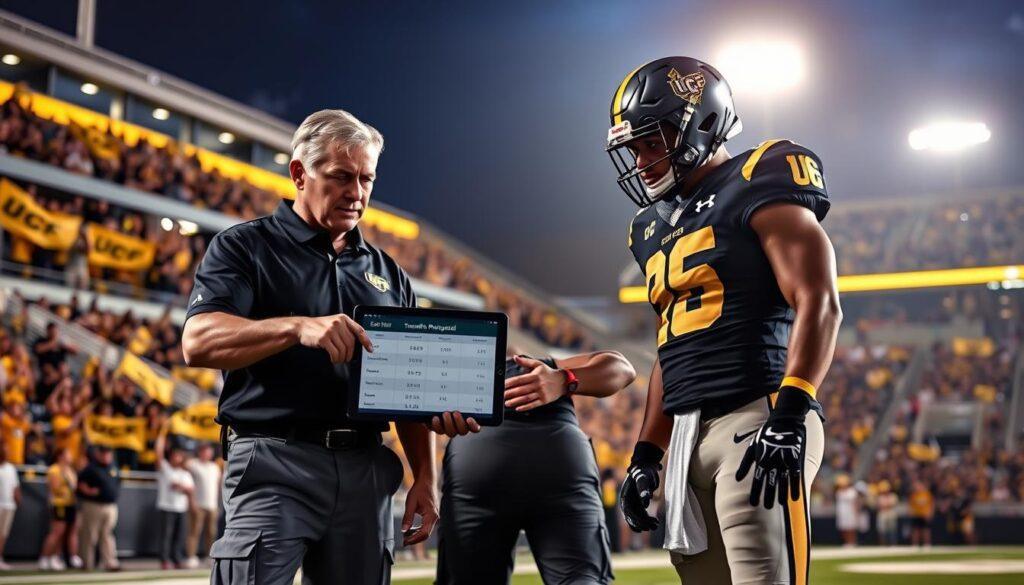
Building trust is tough when half the team is new. Team chemistry isn’t learned overnight. It’s built through hard work and film sessions. Malzahn’s culture must be strong enough to hold this team together.
Will the transfers embrace the “UCF vs. Everybody” spirit? Or will they just be here for personal highlights? The answer will shape the season. This is the real challenge.
| Player | Position | Previous School | Projected Impact |
|---|---|---|---|
| Duane Thomas Jr. | Running Back | Power Five Program | Immediate contributor in power run game |
| Marcus Burke | Wide Receiver | University of Florida | High-ceiling deep threat; consistency is key |
| John Doe (Sample DB) | Defensive Back | Eastern Michigan | Potential starter; adjustment to Big 12 speed |
| Jane Smith (Sample LB) | Linebacker | Sun Belt Program | Adds depth and special teams prowess |
So, how do we grade UCF’s portal haul? It’s an A for ambition and a B for talent. The standout players like Thomas fill specific needs. But there are risks, like fit and attitude, that need careful handling.
In today’s college football, building a team is an ongoing art. This ucf football preview says UCF’s team is a work in progress. The transfers add color, but the coaching staff must create the frame.
Bounce House Stadium Atmosphere
Every home opener, 45,000 people turn into one massive, moving entity. It starts when “Kernkraft 400” by Zombie Nation plays. This is the “First Bounce,” a true home-field advantage in college football. The stadium doesn’t just get loud; it shakes.
This isn’t just a figure of speech. It’s real physics. On a Thursday night, Orlando’s Labor Day weeknight tradition, the energy is raw. The bounce is a primal release for everyone. For visiting teams, it feels like the ground is against them.
So, what’s the effect of a shaky press box? It’s a sensory overload for visitors, disrupting their timing and communication. The environment’s surrealism affects players’ minds before the game starts. For UCF, it’s a boost of energy.
But does it put pressure on the Knights with new players? The data shows they perform well under it. UCF’s home opener record is impressive, making it key for any knights game analysis. The Bounce House is more than a venue; it’s a game-changer from the start.
Calling it the twelfth Knight is fitting. It’s a force that motivates both defense and offense. While we look at playbooks, the real measure might be the seismograph reading. Understanding UCF’s wins means looking at decibels and the chaos of the Bounce House.
Recruiting Trail Implications
UCF’s move to the Big 12 was meant to open doors to top recruits. The idea was to play against Texas and Oklahoma. But, a conference change doesn’t automatically attract top talent. It just means you’re at a more expensive table.
The real battle is on the recruiting trail. Every win or loss matters. It’s like a highlight reel for recruits.
High school recruiting is key, not the transfer portal. It’s a long-term plan in a world that wants quick results. A win in the Big 12 is more than just points. It’s a chance to show off to every recruit in the Southeast.
But, a losing season can make that Big 12 logo a question mark. It’s a big deal for 17-year-olds deciding where to play.
So, what does UCF offer now? Is it a chance to prove something or a promise of the future? The program’s cultural shift is now its biggest selling point. It’s not just about facilities or being in the Big 12. It’s about showing progress.
The game has changed with NIL and revenue sharing. Recruiting is now about tradition, opportunity, and money. UCF must sell a mix of early playing time, Big 12 exposure, and a good NIL setup.
UCF is focusing on Florida and making moves in Georgia and the Carolinas. The early signing day tracker shows a class focused on defense and the offensive line. This shows Frost’s team is selling immediate chances to play.
| Target Position | Primary Region | Key Selling Point | Current Status |
|---|---|---|---|
| Edge Rusher | South Florida (Miami-Dade) | Early rotational snaps in new defensive scheme | Multiple 4-stars in contention |
| Offensive Tackle | Georgia & North Florida | Big 12 exposure & developmental pipeline | Two commits, seeking a third |
| Wide Receiver | Central Florida (Orlando/Tampa) | High-tempo offense & local NIL opportunities | Battling SEC schools for top prospect |
| Cornerback | National (CA, TX, FL) | Conference-wide aerial attacks = highlight tape | Transfer portal leaning, high school backup plan |
The table shows UCF’s focus on key positions and regions. It’s a blueprint for recruiting after joining the Big 12. Recruiting locally and competing nationally is the new strategy.
Success in recruiting will impact future aac football predictions. A strong class sets the stage for success. A weak one means relying on the transfer portal. The Knights must show their on-field product matches their off-field promises. The recruiting trail leads to the future of the program.
Group of Five Playoff Hopes
UCF now faces a new challenge. They’ve moved to a Power conference. This change brings irony to their Group of Five playoff hopes.
They once fought against the Power Six. Now, they’re part of the Big 12. Can they crash the party with an invite?
The expanded playoff offers a chance. It’s for the highest-ranked champion from non-Power leagues. UCF’s identity was built on this hope.
As a Big 12 member, UCF is a test case. The path to a playoff spot is harder. They play Power Five teams every week.
A loss to a rival is a big deal. It could end their playoff dreams.
UCF needs a great season. They must go 10-2 and win the Big 12 championship. A win over a top team is key.
This ucf football preview looks at their schedule. They face tough games and must find big wins.
| Game Type | Opponent Example | Playoff Implication | Risk Level |
|---|---|---|---|
| Trap Game | Mid-tier Big 12 road game | A loss here eliminates margin for error; committee views it harshly. | High |
| Statement Opportunity | Ranked non-conference opponent | Win provides national credibility and playoff resume cornerstone. | Extreme |
| Must-Win | All conference home games | Foundation for championship appearance; any loss is catastrophic. | Medium |
| Season Definer | Big 12 Championship | Likely necessary to be the “highest-ranked champion” from any non-Power league. | Ultimate |
Have the goalposts moved? Fans once dreamed of a playoff season. Now, is just being competitive enough?
Surviving in a Power conference is a big deal. It validates their rise. But for a program built on defiance, survival might feel like a compromise.
This season is a high-wire act. Every game matters for the committee. Every win is a chance to argue. Every loss is a setback.
The dream of being the Group of Five representative is alive. It’s just more challenging now. They must beat teams they weren’t supposed to face.
In this ucf football preview, we see the hope and complexity. The math is harder. The stakes are higher. The whole country will watch to see if they can succeed.
Social Media Engagement & Buzz
Forget the box score; the real metrics of modern fandom are measured in likes, shares, and viral memes. The court is just the opening act. The main event unfolds on X, TikTok, and Instagram, where narratives are won or lost before the post-game presser even starts. For UCF, this digital arena is fertile ground.
The program’s creative teams aren’t just posting highlights; they’re weaponizing nostalgia. The returns of Scott Frost and McKenzie Milton aren’t just coaching moves—they’re content goldmines. Algorithms feast on nostalgia, and the Knights are serving a five-course meal. Remember that week UCF basketball broke Twitter? That’s the blueprint. Organic, meme-worthy buzz is marketing you can’t buy.
So, what does the current feed tell us? The hype videos have evolved from simple montages to cinematic trailers. They’re not just showing plays; they’re selling a vibe, a return to prominence. This level of production doesn’t just hype the die-hards; it pulls casual observers into the orbit of a knights game analysis.

Perhaps the most fascinating shift is in the fanbase itself. The die-hard football crowd is increasingly making room for basketball chatter in the timeline. The “Knight Nation” identity is becoming more holistic, less seasonal. The same accounts that dissect a cover-2 defense on Saturday are now debating a full-court press on Tuesday. This crossover engagement is a program’s dream.
| Platform | Primary Content Type | Fan Reaction Tone | Strategic Value |
|---|---|---|---|
| X (Twitter) | Real-time commentary, memes, debate | Nostalgically Bullish, Skeptical | Narrative shaping, direct fan interaction |
| TikTok | Hype videos, behind-the-scenes, player features | Hopeful, Energetic | Recruiting reach, younger demographic engagement |
| Aesthetic visuals, graphics, story updates | Loyal, Supportive | Brand building, community feeling | |
| Fan Forums/Reddit | Deep-dive analysis, transfer rumor mills | Analytically Skeptical, Detailed | Pulse of the hardcore base, feedback loop |
The overall narrative online? It’s a cocktail of hope, skepticism, and unapologetic bullishness. Every transfer portal entry sparks a mini-thread of forensic analysis. A bad loss might trend, but a resilient fanbase can quickly pivot the conversation to next year’s recruiting class. In 2024, this social Q-rating has tangible effects. It impacts a recruit’s perception of program momentum. It boosts team morale when players see their highlights edited like a superhero trailer.
Ultimately, we’re not just counting likes. We’re taking the temperature of a community in its digital watercooler era. A win gets amplified into a movement. A loss gets dissected, memed, and filed away as motivation. This digital echo chamber is now a critical layer of any knights game analysis. The buzz is real, and it’s loud.
Historical Program Growth Story
The story of UCF athletics is full of exciting moments. Football and basketball have taken turns leading the team. To make smart aac football predictions, you need to know this history. It’s the foundation of their success.
The football program’s rise is legendary. In 2015, they were 0-12, a national joke. Then Scott Frost came in. By 2017, they were 13-0, winning a national title. This was more than just getting better. It was a game-changer in college football.
Here’s how their growth happened in key phases:
- The Reclamation (Frost 1.0): It was more than just a turnaround. It was a complete change. They introduced a new style of play, combining a fast offense with a strong defense. They didn’t just win; they made a statement.
- The Consolidation (Malzahn Era): Gus Malzahn brought his SEC experience to UCF. His goal was to prove 2017 was not a one-time success. He made sure the team was competitive in the AAC, aiming for bowl games as the minimum.
- The Reboot (Now): With a new coach and new challenges, the cycle starts again. But the foundation is set. The team must adapt quickly to stay ahead.
While football was getting all the attention, Johnny Dawkins was building a strong basketball team. UCF basketball was often overlooked. Dawkins focused on defense and toughness. His efforts paid off with an NCAA tournament appearance that felt well-deserved.
The common thread is a relentless growth mindset. This program doesn’t believe in limits. It’s all about pushing boundaries. The lessons from 2017 and 2024 are clear: seize the moment when it opens. Don’t wait for permission.
Today’s team has this history as a powerful tool. It tells them, “We’ve been here before. We’ve achieved the impossible.” This confidence can change the game. It makes them approach every aac football predictions with a different mindset, knowing they can exceed expectations.
The past is not just a collection of trophies. It’s a guide. The football and basketball successes teach a valuable lesson. Sustainable growth comes from a strong identity, not just talent. This is the edge that no algorithm can replicate.
Key Player Development Stories
The transfer portal gets all the attention, but the real story is in player development. For a serious ucf football preview, this is key. It shows who’s ready to shine.
Coaches turn raw talent into stars. It’s not just about signing names. It’s about building a player from scratch. Who’s on the verge of a big season at UCF?
At quarterback, Tayven Jackson and Jacurri Brown are the top prospects. They have huge talent. With Gus Malzahn and Darin Hinshaw guiding them, their growth is exciting.
Players like John Walker, returning from injury, are also key. He’s a former top recruit looking to prove himself. His return could change the game for UCF’s defense.
On offense, players like Dylan Wade and Waden Charles showed promise last year. They could be the game-changers this season.
- Tight End Dylan Wade: He showed reliable hands and quickness. Could he be a key player this year?
- Wide Receiver Waden Charles: He’s fast. With more practice, he could be the deep threat UCF needs.
Players like Wade and Charles are the heart of a team. Developing them is about building lasting success. It’s not a quick fix.
As you read this ucf football preview, think about which player’s growth will make a difference. Will it be the quarterback, the injured star, or the young receiver?
The answer could make all the difference. Transfers might win games, but developed players create an identity.
Weather & Game Conditions
Forget the X’s and O’s for a moment. The Central Florida humidity might be the real game-changer tonight. Our knights game analysis must consider more than just playbooks. We’re talking about the atmosphere, literally.
Thursday, August 28, 7:00 p.m. ET in Orlando. The weather is far from perfect. It’s a hot, humid evening, making the field feel like a griddle.
For Jacksonville State, it’s a tough challenge. But for the Knights, it’s their home turf. Being at home gives them a tangible strategic edge. Acclimation is key, as it affects performance in this thick air.
The humid air affects footballs, making them harder to throw and kick. Precision becomes even more important. This changes the game.
Depth charts are put to the test. Teams with deeper rotations can stay fresh longer. This is critical in the heat.
UCF has mixed results in this early-season heat. Home-field advantage is a double-edged sword. They know what’s coming but also feel the pressure.
The Thursday night slot is unique. No weekend clutter. The spotlight is intense, making every mistake stand out. This adds to the psychological challenge.
In conclusion, a proper knights game analysis must include the weather. The conditions are not just a footnote. They can change the game, affecting tempo and outcome.
Post-Game Championship Scenarios
The final whistle blows. UCF 35, Jacksonville State 21. What does it mean? It’s just the start of the season’s story.
A win like this does more than just add a ‘W’. It shows the team is ready for the future. It builds excitement and support. For UCF aiming for the Big 12, this is a big step.
But what if it was a close game or an upset? That one score changes everything. Panic is not helpful. Instead, it’s time to adjust and move forward.
Our analytics lab starts here. That first game score affects all our predictions for the season. A strong start makes UCF a top pick. A loss makes them uncertain.
We explore the possible paths ahead. One game can change everything. It’s not about winning or losing. It’s about where the team is headed. Just as studying Alabama college football history shows how a single game can define a season, analyzing UCF’s matchups highlights the turning points that shape their journey.
Is UCF on its way to the playoffs, or fighting to stay in the game? The answer lies in the data. And the data is just starting to speak