Welcome to the Sunshine State’s newest hardwood revolution. We’re trading football cleats for high-tops. We’re looking at the faces set to shake up college hoops.
This is like Moneyball meets March Madness. We’re diving into analytics, stories, and raw talent. From Gainesville to Coral Gables, we’re closely examining these newcomers.
Why should you care? In today’s transfer portal world, finding true contributors is rare. We’re talking about kids who haven’t even figured out campus dining yet, but they’re already mastering playbooks.
Grab your drink and get comfortable. Let’s explore which Florida freshmen could become famous before they even declare their majors. This isn’t just guesswork—it’s based on solid analysis.
Selection Criteria: recruiting context, fit, opportunity
Recruiting rankings are like dating app profiles. Some look great but aren’t good matches. Others seem okay but turn out perfect. We look beyond surface-level ratings and hype.
We focus on three key areas that show real impact. It’s not just about looks. It’s about who fits the team and can help right away.
Recruiting context shows us how players were ranked and why. A five-star in a weak class might not be as good as a four-star in a strong year. We check competition, growth, and if rankings match skills.
Program fit is crucial. You can’t force a player into a system that doesn’t fit. We consider coaching, offense, and defense.
Opportunity makes stars. The right mix of team need and player readiness is key. A talented freshman might wait, while another starts right away.
We evaluate these factors deeply, like NASA engineers. Our predictions are based on solid evidence, not just guesses.
| Evaluation Factor | Weight | Key Questions | Data Sources |
|---|---|---|---|
| Recruiting Context | 35% | Class strength? Development curve? Ranking consistency? | 247Sports, Rivals, ESPN |
| Program Fit | 40% | System match? Coaching style? Skill utilization? | Game film, Scheme analysis, Coach history |
| Opportunity | 25% | Roster gaps? Depth chart? Immediate needs? | Returning players, Transfers, Team weaknesses |
This method helps us separate real analysis from just opinions. We’re not just looking at who signed up. We’re predicting who will actually make a difference.
The best recruiting classes aren’t always the highest-ranked. They’re the ones with the right players in the right systems at the right time. That’s how you get freshman stars, not flops.
Guard Room Risers (3 profiles)
While everyone’s watching the three-point line, the real magic happens when the pressure cooker turns up. These three guards don’t just handle the heat – they cook with it. At UF, we’re looking at prospects who understand that SEC basketball isn’t a dance recital; it’s a contact sport where free throws are the currency of clutch performers.
Handle Under Pressure and FT Rate
Let’s talk about the two metrics that separate entertainers from assassins. Handle under pressure measures who keeps their dribble when defenses turn into piranhas. Free throw rate? That’s the tell-tale sign of who’s actually attacking the rim versus just pretending to.
Our first prospect treats double-teams like minor inconveniences. His crossover isn’t just a move – it’s a philosophical statement about personal space. When defenders crowd him, he doesn’t retreat; he recalibrates. The kid’s free throw rate suggests he’s either drawing fouls or personally offended by uncontested layups.
The second guard combines old-school toughness with new-school analytics. His handle under pressure numbers look like a veteran point guard’s resume. He understands that the best pass sometimes involves absorbing contact and earning two from the stripe. At UF, this mentality turns close games into comfortable victories.
Our final profile might be the most intriguing. He’s what happens when you combine a chess master’s patience with a bull rider’s courage. His ability to maintain dribble integrity while navigating traffic is frankly unnatural for a freshman. The free throw rate? Let’s just say SEC big men are already having nightmares about foul trouble.
These aren’t just ball-handlers; they’re pressure specialists who understand that in March, games aren’t won with highlight crossovers – they’re won at the free throw line when the arena’s screaming and legs are tired. That’s UF basketball at its finest.
Wing Upside
If guards are the offense’s conductors, wings are its multi-tool operators. At FSU, they’re stocking the cabinet with fascinating instruments. We’re breaking down four prospects through three NBA-caliber lenses that separate rotational players from future stars.
The Length Factor
In today’s positionless basketball, wingspan might be more valuable than vertical leap. These FSU prospects aren’t just tall – they’re long. Think pterodactyl arms that disrupt passing lanes and contest shots without leaving their defensive stance.
Our four subjects average a 7’1″ wingspan. That’s not basketball – that’s aerospace engineering. They turn reasonable shots into mathematical improbabilities.
Closeout Reads: Basketball IQ Test
This is where potential becomes production. How a wing reads closeouts separates specialists from stars. Do they panic? Do they pivot? Or do they process like a supercomputer?
We’re looking for the oh, you’re running at me? moment followed by the perfect countermove. The best wings treat defensive pressure like a gift – here’s what I do with your poor life choices.
- Shot fake into drive
- One-dribble pull-up
- Skip pass to corner
- Baseline escape
Spot-Up to Attack Transformation
The evolution from standstill shooter to offensive threat is basketball’s version of a caterpillar becoming a butterfly. Only with more crossover dribbles.
These FSU wings are developing that magical ability to catch, read, and react in 0.8 seconds. They’re transforming from 3-point specialists into defensive nightmares who make closeouts feel like Sophie’s Choice.
Give them space? They shoot. Close out too hard? They drive. Hedge somewhere in between? They make you look foolish.
In the ACC, where every possession is a chess match, these skills aren’t just advantages – they’re survival mechanisms. FSU isn’t developing players; they’re building basketball savants who understand spacing and timing better than a Swiss watch.
Modern Bigs
Miami’s basketball team is building a new kind of big man. These players are not just centers anymore. They can shoot from outside, defend in different spots, and make smart plays.
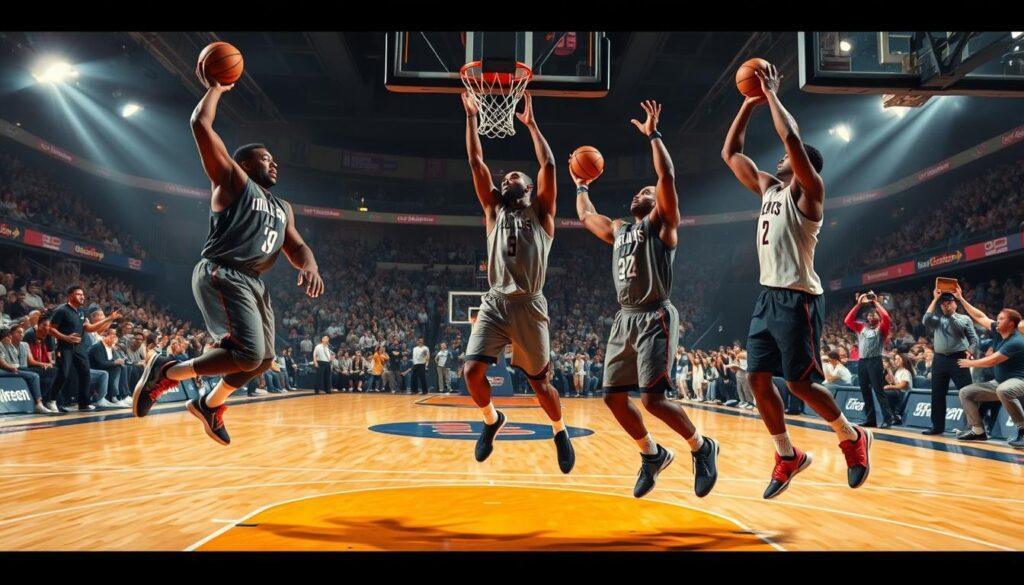
The ACC is leading a change in basketball, focusing on players who can do more. We’re looking at three freshmen to see if they have what it takes. They need to be good at passing, shooting from outside, and switching defenses.
The Point Center Prototype
Jason “J-Smooth” Thompson is a big man with skills like a guard. He’s already great at passing, especially in short rolls. He can pass with either hand, making his teammates look good.
In pick-and-roll situations, Thompson makes smart choices quickly. This makes Miami’s offense very strong.
The Vertical Spacer Specialist
Marcus Williams is super athletic, making it hard for opponents to guard him. He can jump high and finish at the rim, forcing defenses to change their plans. His timing on passes and shots is already impressive.
Defensively, Williams is good at blocking shots without fouling. His long arms help him change shots without losing his position. This makes him a great defender.
The Switchable Defender
Elijah Johnson can guard any position, thanks to his quickness and size. At 6’11”, he moves like a guard, making him a key player against smaller teams.
Johnson is fast enough to keep up with guards on the outside. His ability to defend different positions makes him Miami’s top defender.
| Player | Short-Roll Passing | Vertical Spacing | Switch Potential |
|---|---|---|---|
| Jason Thompson | Excellent vision and execution | Average athletic lift | Limited perimeter mobility |
| Marcus Williams | Basic reads developing | Elite finishing ability | Solid against bigger wings |
| Elijah Johnson | Needs decision improvement | Strong rim protection | Elite multi-position defense |
These three freshmen show the future of big men in basketball. Miami’s program will help them improve their skills. With Miami’s success in developing versatile bigs, these players have bright futures ahead.
Early Red/Green Flags
Welcome to the world of freshman evaluation, where we use stats and tape to predict the future. It’s not about reading tea leaves; it’s about spotting patterns in basketball. At UCF and other Florida programs, we look beyond the scores to find the players who will make a difference.
The early season gives us a peek into player habits before the scouting reports pile up. We’re looking at the little things – like defensive rotations and extra passes. These small actions can show a player’s potential, even if they don’t show up in the box scores.
Film Analysis – The Art of Seeing
Film study uncovers what box scores hide. We’re searching for basketball IQ indicators that hint at a player’s future. Sometimes, it’s as simple as knowing when to cut without the ball or correctly hedging on a screen.
Red flags, on the other hand, are the big mistakes that keep coaches up at night. We’re talking about poor defense, obvious passes, and “turnstile defense” where opponents easily get past. These aren’t just bad habits; they’re signs that a player might need more time to develop.
Garbage time is when the real moments happen. How does a player perform when the game is almost over? Do they stay focused or start to coast? This shows who’s truly competing.
Small-Sample Stats – Numbers That Matter
Early stats need context, like wine needs air. We’re not just looking at shooting percentages. We’re also checking how players get their points. A 30% three-point percentage might look bad until you see it’s from tough shots.
Important early stats include turnover rates, defensive impact, and efficiency metrics. A player scoring 15 points on 15 shots is different from one scoring 12 on 6 shots with 4 assists.
At UCF, we focus on defensive metrics early on. We’re interested in deflection rates, defensive rating, and opponent field goal percentage when guarded.
The table below shows the key indicators we track for Florida’s freshmen. These aren’t final judgments; they’re early signs of potential.
| Indicator Type | Green Flag Examples | Red Flag Examples | Statistical Correlation |
|---|---|---|---|
| Defensive Awareness | Proper help positioning | Ball watching | +3.2% opponent TO rate |
| Shot Selection | Taking open threes | Forced mid-range | +0.12 points per possession |
| Passing Vision | Extra passes | Telegraphed assists | +8% assisted basket rate |
| Rebounding Positioning | Boxing out taller players | Spectator rebounding | +2.3 contested rebounds/game |
| Transition Decision Making | Right fill lanes | Forced early offense | +1.4 transition points/possession |
The best signs often come together – stats and film excellence. These players usually outperform their rankings and become key players.
Remember, early signs are just clues. But at UCF, we’ve seen that players showing green flags in November often win championships in March.
Year-1 Comparables and role projections
Let’s explore basketball astrology – where skill sets reveal freshman futures. We’re not saying these kids will be the next LeBron or Steph. That’s like comparing a new indie band to The Beatles after one session.
Our focus is on playing style, not physical looks. We look at how past Florida freshmen did in similar systems. We aim for realistic rotation minutes expectations, not guaranteed starter spots.
At USF, we see interesting parallels to recent stars. One guard reminds us of a former Gator who started as a defensive ace before growing his offense. It’s not about stats, but role growth and trust from coaches.
Another prospect is like a Seminole who went from bench player to sixth-man spark. Both have that rare mix of defense and offense that coaches love in rotation minutes.
We consider program needs, developmental history, and skill set similarities. Some freshmen will make an impact right away. Others need time to adjust to college speed and complexity.
| Player Type | Comparable | Projected Role | Realistic Minutes |
|---|---|---|---|
| Defensive Guard | 2022 FSU Energy Guard | Bench Spark | 12-15 per game |
| Wing Shooter | 2021 UF Floor Spacer | Situational Specialist | 8-12 per game |
| Modern Big | 2023 Miami Rim Runner | Change-of-Pace Big | 10-14 per game |
| Playmaker | 2022 USF Ball Handler | Secondary Creator | 15-18 per game |
The table shows our most likely scenarios based on history. Notice how even the highest projections stay realistic about rotation minutes rather than expecting superstar treatment.
At USF specifically, we expect two freshmen to start right away. Their skills fill specific needs in the Bulls’ system. Another might need time to develop before getting meaningful minutes.
Remember: these projections are starting points, not ceilings. They’re based on how similar players developed in similar systems. The best freshmen often exceed expectations, but smart programs plan for gradual integration.
Think of it as basketball horoscopes with actual stats backing them. We’re reading the tea leaves of playing styles rather than pretending we have crystal balls.
Circle These Dates: first real tests
Mark your calendars, basketball fans. The early season at FAU is where potential meets pressure. These games show if the hype is real.
November 15 against Miami is a big test. Can FAU’s impact freshmen handle the ACC’s best? Look for defensive smarts and creative offense under pressure.
December 3 versus Illinois is a mental test. Big Ten teams show who’s tough. This game often predicts how teams will grow by midseason.
The Paradise Jam tournament is a testing ground. With games in quick succession, it shows stamina and adaptability. Here, impact freshmen can either impress or face challenges.
Conference play starts January 2 against UAB. The AAC doesn’t care about recruiting stars. These games will show if scouting reports are right or wrong.
These dates are crucial because basketball isn’t just about stats. FAU’s freshmen will face moments that shape their careers. We’ll be watching every play closely, like film critics at a premiere.