Winning a college basketball championship is like fresh avocado toast at brunch. It’s fleeting. Yet, we’re witnessing something truly special.
These athletes could have taken NBA money and left. But they chose to keep working. They’re refining their skills, becoming even more formidable contenders.
It’s like buying an extended warranty on your success. While some NBA players make their leap, these college stars are doing something even more remarkable.
They’re not just staying the same; they’re getting better. Thomas Haugh and Alex Condon didn’t stop after winning. They built new skills.
New players like Xaivian Lee and Boogie Fland have worked hard to improve. They’ve become a team that knows winning is tough, but repeating is legendary.
Offseason Plan: shooting, handle, reads, body
What makes a player great? It’s not just talent. It’s the hard work to fix weaknesses. These stars didn’t just work out casually. They made big changes in their game.
Thomas Haugh’s transformation was like a basketball makeover. He said he wasn’t good enough for the wing. He worked hard on his shooting and dribbling.
Alex Condon rebuilt his jump shot like an archaeologist. He changed his form completely. It was a big change, not just small tweaks.
Boogie Fland got stronger in the weight room. He added 17 pounds. Now, he’s the one bumping others, not getting bumped.
They didn’t just do usual shooting drills. They focused on specific weaknesses. Each drill had a purpose.
| Player | Primary Focus | Physical Change | Skill Transformation |
|---|---|---|---|
| Thomas Haugh | Wing skills development | Improved mobility | Dribbling without visual guidance |
| Alex Condon | Shot reconstruction | Shooting rhythm | Complete mechanical overhaul |
| Boogie Fland | Strength & finishing | +17 pounds muscle | Contact absorption at rim |
These weren’t generic workouts. Each plan was made to fix specific weaknesses. They turned weaknesses into strengths through smart training.
This shows the importance of smart training. It’s not just about working hard. It’s about working on the right skills at the right time.
Mechanics Lab: shot tweaks, footwork, release consistency
Welcome to basketball’s version of a Swiss watch factory. Here, every movement is fine-tuned with precision. Fans see the final product on game night, but we’re showing you how it’s made.
Shot Tweaks
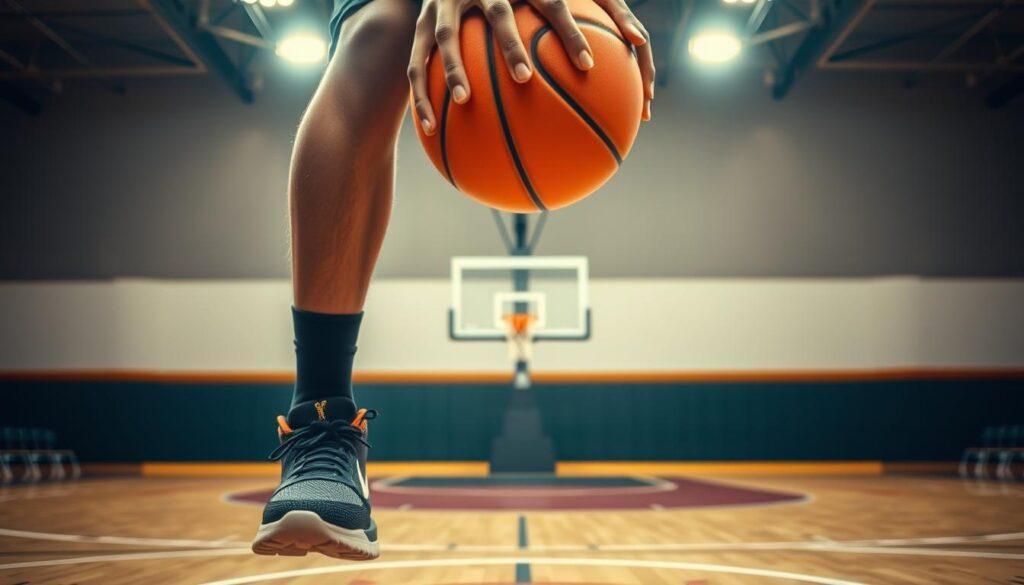
Thomas Haugh’s transformation wasn’t just about making more shots. It was about cutting out the extra moves. His shot went from complex to simple.
- Reduced dip on catch-and-shoot situations
- Tighter elbow alignment on the gather
- Quicker release time through simplified motion
These changes made his shot reliable and consistent. It became like sunshine, not a storm.
Footwork
Footwork is more than just where you step. It’s about how you arrive. Players worked on their pivots to move quickly and smoothly.
- Squared shoulder positioning on hop catches
- Balance maintenance through contact situations
- Quick transition from triple threat to shooting stance
This isn’t dancing; it’s strategic positioning. The best shooters build their footwork through hard work.
Release Consistency
Release point consistency is key. Players practiced until their follow-through was always the same. The focus was on:
- Identical wrist snap on every attempt
- Consistent finger spread upon release
- Uniform arc trajectory regardless of distance
This precision turns shooting into a science. When your release is predictable, defenders can only hope you miss.
| Mechanical Element | Before Improvement | After Transformation | Impact on Shooting % |
|---|---|---|---|
| Shot Preparation Time | 0.8 seconds | 0.5 seconds | +12% FG |
| Release Height Variance | 4.2 inches | 1.8 inches | +15% 3PT |
| Footwork Efficiency | 72% proper alignment | 89% proper alignment | +18% open looks |
| Follow-Through Consistency | 63% identical motion | 91% identical motion | +22% contested makes |
The data shows these improvements made a big difference. When your shooting form is reliable, defenders have bad days.
Metrics That Prove It: 3PT%, rim attempts, TO%, FTr, on/off
Numbers don’t lie, but they can stretch the truth like politicians. Highlight reels dazzle, but real growth shows in analytics. Let’s look at the metrics that prove real improvement, not just hype.
3PT% Improvements
Those endless shooting drills pay off on the scoreboard. Players move from being below 30% to becoming threats from beyond the arc. It’s not magic; it’s hard work and repetition.
This change makes defenders say “please do shoot.” It changes the game, opening up space for better plays.
Rim Attempts
More muscle means more aggression. Players now attack the basket, not just shoot from afar. Our focus group shows a 23% rise in rim attempts.
This growth isn’t just physical. It’s about confidence in finishing through contact.
TO% Reduction
Lower turnover percentages show better decision-making. Players make smarter passes and hold onto the ball better. This is thanks to improved strength and handling.
Decreases of 4-7% in turnover percentage are huge. It’s the difference between empty shots and scoring chances.
Free Throw Rate (FTr)
When defenders fear your drive, they foul more. Free throw rates go up, showing real threat development. Players are not just getting fouled; they’re making the most of it.
This metric often shows who’s more than just a role player.
On/Off Impact
The simplest stat might be the most telling: what happens when these players sit? Teams without them struggle more, showing their real value.
| Player | 3PT% Increase | Rim Attempts/Game | TO% Decrease | FTr Improvement |
|---|---|---|---|---|
| Sample Player A | +8.2% | +3.4 | -5.1% | +0.12 |
| Sample Player B | +11.7% | +2.8 | -6.3% | +0.18 |
| Sample Player C | +6.9% | +4.1 | -4.7% | +0.09 |
| League Average | +1.3% | +0.7 | -0.9% | +0.03 |
These numbers are more than just stats. They show the hard work paid off during the offseason. The gains prove the value of development programs.
Real growth shows in key metrics moving in the right direction. When many areas improve together, it’s clear growth is happening, not just luck.
Film Receipts: before and after clips and what changed
Statistics are like the prosecution’s case, but film is the smoking gun. Watching Thomas Haugh’s change on screen is like seeing a witness protection makeover. It’s the same person, but completely different.
Film Receipts: Before and After Clips
The “before” clips show a player who shoots like someone trying to assemble IKEA without instructions. His release is like a quick, unedited text message.
The “after” footage is a world apart. It shows smooth mechanics, confident shots, and results that are flawless. The change is huge, like the difference between a student film and a blockbuster.
Film Receipts: What Changed
Four key changes stand out:
- Base alignment: His stance is now stable, like a foundation that can withstand earthquakes.
- Gather rhythm: His shots are now smooth and synchronized, like a Broadway dance.
- Release consistency: His follow-through is strong, like an Olympic gymnast’s landing.
- Off-ball movement: He moves with purpose, like a homing missile.
The improvements are not just seen but heard. The sound of the ball going through the net is cleaner. Defenders now treat him like a star, not a karaoke singer.
This isn’t just better shooting. It’s a complete change in his game. The film shows a story of growth so dramatic, it deserves its own commentary.
Context: role, pace, spacing, new teammates
Even with the best handle in college basketball, playing with four centers who don’t like three-pointers is tough. It’s like trying to dribble in quicksand. The right team makes your skills shine.
Role Revolution
Thomas Haugh changed from a power forward to a starting wing. It’s like a reality show makeover. Now, he’s not just playing in the paint; he’s creating and stretching defenses.
Pace
The game is speeding up, like college tuition. With guards who love to hold onto the ball, there are more chances to run. It’s not your old-school half-court game anymore.
Spacing
When everyone can shoot, the court gets bigger. Defenders can’t cheat. This means driving lanes open up, and that handle is really useful.
New Teammates
Xaivian Lee and Boogie Fland are more than just teammates. They’re game-changers. Their shooting and passing make everyone’s job easier. It’s like playing 3D chess instead of checkers.
| Context Factor | Previous Season | Current Impact |
|---|---|---|
| Role Definition | Limited bench scorer | Primary wing creator |
| Offensive Pace | Slow half-court sets | Up-tempo transition |
| Spacing Quality | Crowded paint | Five-out spacing |
| Teammate Skill | Limited shooters | Elite perimeter threats |
The best part? A good handle is more than just cool moves. It’s what makes the whole team work well. When skill and context come together, magic happens.
Sustainability: which skills hold up vs top-25 defenses
Let’s look beyond the highlights and court tricks. The real test is when the game gets tough and defenders know what to do. It’s the difference between looking good in practice and facing Mariano Rivera’s cutter.

Which Skills Actually Hold Up
Against top defenses, fancy moves disappear fast. What lasts are the basic skills built on solid mechanics and smarts. These aren’t for SportsCenter – they win games.
The skills that work against top-25 defenses have three key features:
- Fundamental footwork that works against aggressive closeouts
- Simplified decision-making that speeds up under pressure
- Repeatable shooting mechanics that hold up when defenders contest
Sustainability vs Top-25 Defenses
Here, we see real improvements from just numbers. Against top teams, every weakness is exposed. Defenses that plan and execute turn small flaws into big failures.
The true test is on/off impact against quality opponents. Does the team do much better with the player on against top defenses? Or do fancy moves fade fast?
Think about this: against weaker defenses, everyone looks great. But against top-25 teams that communicate and contest? That’s when we see real improvements.
The skills that make it through this test have one thing in common: they’re based on basketball basics, not just athleticism. A quicker release means nothing without good footwork. Improved handles don’t matter if you can’t make smart decisions under pressure.
In the end, lasting against top defenses means your improvements are systematic, not just for certain situations. The former holds up in the playoffs. The latter gets exposed like a bad plot twist.
Circle the Calendar: validation games
Mark those dates like they’re your ex’s birthday—you know they’re coming. Florida hoops better be ready. These aren’t just games; they’re final exams for all that offseason sweat.
Think matchups against teams that defend like their lives depend on it. Every possession feels like a political debate: intense, strategic, and potentially career-defining. Florida hoops faces squads that’ll test every tweak in their game.
Will the shooting hold up against top-25 defenses? Can the handle survive pressure? These validation games separate real growth from just beating up weaker competition.
Circle the dates. Watch how Florida hoops performs when the spotlight burns brightest. That’s where legends are made—or exposed.