Welcome to the deep freeze of hockey analysis. Before we dive into the game, let’s explore how this team came to be.
Forget the usual sports story where a superstar leads the team to victory. Florida’s journey is more like finding hidden gems in thrift stores.
How did a team with a spotty draft history become a league powerhouse? The secret lies in the team’s ability to find value in overlooked players.
This team is built from second chances and players picked up on waivers. It’s not just luck. It’s the work of a pro scouting operation that turns others’ mistakes into success.
Look at the roster. Sam Bennett, Brandon Montour, and Gustav Forsling were once distressed assets. GM Bill Zito saw their value and brought them to Florida. He knew how to find players who were undervalued by others.
These players became the heart of a championship team. The lesson is clear: building a winner is about finding the right pieces, not just the brightest star.
Understanding this slightly sarcastic genius is key. It sets the stage for what’s to come in this preview. Now, let’s see how this unique team faces its next challenge.
Current Season Form & Standings Impact
After winning championships, teams often face the question, “Can they do it again?” For the Florida Panthers, the real question is, “How efficiently are they doing it now?” They’ve shown they’re building a genuine dynasty with three Cup Final appearances and two titles. Now, the regular season tests their focus, system, and ability to handle pressure.
Last season, the Panthers scored 98 points. They were strong defensively, allowing just 2.72 goals per game. This made them the league’s seventh-best defense. They’re not looking to score a lot of goals; they aim for steady, efficient wins.
But, dynasties can get complacent. Are the Panthers feeling too comfortable after their championships? Their current standings show part of the answer. Are they leading comfortably or fighting for every point? Each situation affects their mindset.
To understand their progress, let’s compare their current season with their last championship. This comparison helps see if they’re just repeating their success or improving it.
| Stat Category | Current Season Trend | 2024-25 Championship Season |
|---|---|---|
| Points Pace | On track for 100+ points, showing sustained elite performance. | 98 points (Actual) |
| Goals For / Game | Solid but unspectacular; winning close, low-event games. | Middle of the pack; offense was timely, not overwhelming. |
| Goals Against / Game | Continuing the sub-3.00 trend; defensive system is intact. | 2.72 (7th in NHL) |
| League Defensive Rank | Consistently in the top 10; a non-negotiable team pillar. | 7th |
| Standing (Division) | Firmly in the top 3, battling for home-ice advantage. | Strong playoff position secured. |
The data shows the Panthers are consistent. They’re not changing much; they’re just making their machine better. Their standings show they’re climbing steadily, not desperately. This suggests they’re ready for a long playoff run, not just fighting for their identity.
As noted in a detailed season preview, their defense was key to their success. It remains their strength.
This means they’re on a winning streak. The Panthers have the momentum. They’re defensively solid, strategically patient, and standings-secure. They’re a team peaking with purpose. Their mix of legacy and urgency makes them a tough opponent and an interesting subject for panthers hockey predictions.
Line Combinations & Power Play Units
If hockey lines were movie casts, the Panthers’ top six would be a blockbuster ensemble. It has the veteran star, the clutch performer, and the scene-stealing agitator. This isn’t just a list of names on a whiteboard. It’s a living, breathing system with its own unique chemistry. My job is to decode it for you.
At the heart of the second line sits Sam Bennett. He’s like a Swiss Army knife, a master at getting under opponents’ skin while winning key draws. He creates space through pure, beautiful annoyance. Flanking him, you often find Carter Verhaeghe. Remember his playoff overtime heroics? That clutch gene is permanent. He’s a top-six fixture because he finds quiet ice and then makes a loud noise.
The plot thickened with the trade deadline acquisition of Brad Marchand. Inserting a veteran of his caliber and, let’s say, competitive spirit is like adding a new spice to a proven recipe. It changes the flavor profile. Has his integration pushed someone down? Or has it created a more versatile, dangerous top-nine look? This is the granular chess match I live for.
| Unit | Likely Combination | Primary Role & Catalyst |
|---|---|---|
| First Line | Barkov – Reinhart – Marchand | Two-way dominance & elite finishing. Sets the defensive tone. |
| Second Line | Bennett – Verhaeghe – Tkachuk | Puck possession & net-front chaos. Wears down defenses. |
| Power Play QB | Gustav Forsling | Two-way defender with a sneaky good shot from the point. |
Now, let’s talk special teams. The power play is where systems and talent either harmonize or clash. Is Florida’s unit a well-oiled, shot-generating machine? Or does it sometimes overpass, looking for the perfect play? A key piece of this nhl game analysis is the man-advantage structure.
Gustav Forsling has emerged as a key quarterback. His two-way dominance at even strength translates. He’s calm, makes the smart first pass, and isn’t afraid to let a shot go. But who’s the net-front presence? That’s often where the game is won. Screening the goalie, battling for rebounds—it’s a dirty job, but someone has to do it.
Against a disciplined penalty kill, which matchup unlocks the game? Is it Forsling’s point shot finding a lane? Or is it the down-low cycle game with Bennett and Tkachuk creating havoc? This level of detail separates casual viewing from true nhl game analysis.
The synergy between these units defines Florida’s offensive identity. When the lines are rolling and the power play clicks, they’re nearly unstoppable. When the chemistry is off, the whole engine can sputter. Understanding this dynamic is key for fans and analysts.
Goaltending Matchup & Save Percentages
Goaltending analysis often focuses on just a few numbers. But the battle between Sergei Bobrovsky and his opponent is more than that. It’s a story of skill, pressure, and possibility. On one side, a two-time Vezina winner with surprising early-season stats. On the other, a goalie whose form might be the reason his team is in the playoffs. It’s not just numbers; it’s a show.
First, let’s talk about Bobrovsky. His .873 save percentage and 3.71 goals-against average are concerning. For a florida panthers preview, this is a major warning sign. Yet, the team seems confident. Bobrovsky himself said, “I’m not happy with that… I believe in hard work… I know the numbers can be better and have to be better.” His words carry weight.
Bobrovsky has a history of turning things around in November. He’s known for slow starts followed by a surge. Betting against him bouncing back is risky. This nhl game analysis must consider his past success.
Now, let’s look at the opposing goalie. The contrast is clear. While Bobrovsky searches for his best form, the other goalie has been steady. His numbers are better, and his calm demeanor is reassuring. But does he face the same quality of chances? Does his defense let him down?
To understand the goaltending matchup better, we need to look at more than just save percentages. The table below shows key metrics beyond basic stats.
| Metric | Sergei Bobrovsky (FLA) | Opposing Goalie | League Average |
|---|---|---|---|
| Games Played (GP) | 12 | 15 | N/A |
| Save % (SV%) | .873 | .917 | .905 |
| Goals Against Avg. (GAA) | 3.71 | 2.45 | 2.95 |
| High-Danger SV% | .780 | .845 | .815 |
| Quality Start % | 33% | 67% | 53% |
The table shows the real fight. Bobrovsky’s high-danger save percentage is alarming. It means he’s struggling with the toughest shots. His opponent, on the other hand, is doing well in this area.
So, who will win the duel? It might depend on who gets more support. Bobrovsky needs his defense to help him out. Can they do that? If so, his talent will shine. For the other goalie, the question is if he can keep up his great play.
This nhl game analysis comes down to one moment. The save that changes the game. Bobrovsky can make that save, even now. His opponent has been doing it all season. That’s the tension. That’s the goaltending matchup we’re all waiting for.
Defensive Pairings & Special Teams
The defensemen are key in hockey, and the Panthers’ blue line shows different approaches. Gustav Forsling is a hidden gem, loved by stats. Brandon Montour plays with urgency, facing free agency.
Paul Maurice calls Forsling the best shutdown defenseman. His stats back it up, leading the team in advanced metrics. He makes the top line of the opposing team hard to reach.
Montour brings speed and offense from the back. His contract status adds a twist. Forsling’s solid play helps balance Montour’s riskier moves.

Special teams are key in hockey. The Panthers’ penalty kill is top-notch, stifling opponents. Their aggressive system makes it hard for teams to pass.
The Panthers’ power play is also strong. It can change the game’s momentum. Success here is critical in close games.
Looking at defense and special teams reveals the game’s hidden wins. It’s about making smart, small decisions. The Panthers’ mix of stats and motivation makes their defense interesting.
Injury Report & Lineup Changes
Analyzing a Florida Panthers preview means looking closely at the injury list. It’s not just about who’s out. It’s a key part of the game plan.
The NHL injury report is full of creative language. “Lower-body injury” could mean anything from a small issue to a big problem. “Game-time decision” usually means the team is hoping for a miracle. Fans and analysts have to guess what’s really going on.
Why is this so important? Losing one player can change everything. Remember when players like Trocheck or Matheson got hurt? It wasn’t just about finding a replacement. It affected the whole team’s strategy.
When a key player is out, a lesser-known player has to step up. This can mess up the team’s plans. The other team might see this weakness and take advantage of it.
So, who will step up next? This is a big question in today’s hockey. It’s not just about skill. It’s about fitting into the team’s plan. Can the new player do the job of the injured player? If not, the other team might get an edge.
This season, there’s another factor: players whose contracts are up. If a player with a contract issue gets hurt, it’s a big deal. Is it a real injury or a way to avoid paying them? These small changes can tell a lot about a team’s future plans.
For the Panthers, every player is important. They have a specific role in the team. If someone is missing, it can mess up the whole system. The team has to adjust, which can make things harder.
This part of the Florida Panthers preview might not be exciting. But it’s essential. If you ignore the injury report, you’re missing the point. Understanding it helps you see the real challenges the team faces tonight.
Coaching Strategy & System Analysis
If hockey were chess, Paul Maurice plays a relentless, board-controlling style. His opponent must decide whether to engage in the trench warfare or try to skate around it. This tactical duel is the core of any serious nhl game analysis.
Maurice has forged the Panthers into a specific, brutal archetype. Forget finesse; think controlled chaos. His system is a three-act play of pressure, structure, and pain.
- The Forecheck as a Weapon: It’s a layered, aggressive hunt. The first forward (F1) charges in to disrupt, F2 supports and seals walls, and F3 hangs high, ready to pounce on a loose puck. The goal isn’t just retrieval; it’s to create turnovers in the offensive zone and punish defenders.
- Defensive Structure: When they don’t have the puck, Florida morphs into a stifling, mid-ice wall. They often employ a 1-3-1 or a tight neutral zone trap, forcing opponents to make risky, long passes that turn into Panther rushes the other way.
- Unapologetic Physicality: This isn’t a side effect; it’s the engine. Finishing every check wears down skill players and shortens the game. It’s a meat-grinder approach, and Maurice has the personnel to run it.
The beauty—or brutality—of this system is its predictability for the players within the team. It calls back to an old Joel Quenneville insight about goalies: players thrive on “certain patterns you’re comfortable with.” For the Panthers, Maurice’s system provides that blueprint. Everyone knows their role in the systematic symphony of chaos.
This creates the central strategic dilemma for the opposing coach. Does he try to match Florida’s heaviness, shift-for-shift? That’s a dangerous game of chicken. Or does he pivot to a speed-and-space counterattack, using quick puck movement to bypass Maurice’s meat-grinder before it engages?
The in-game adjustments are where coaching acumen gets tested. Does Maurice get the last line change at home to hound the opponent’s top unit with his best checkers? How does he deploy his defensive pairings? You can expect Aaron Ekblad’s pair to see heavy minutes against the other team’s stars, tasked with closing space with sheer force.
Will the opponent’s coach shorten his bench early, leaning on his top two lines to out-skill the matchup? Or will he roll four lines, hoping fresh legs can outlast the Panther’s physical toll? This chess match on the bench directly dictates the flow on the ice. Understanding this layer is what separates casual viewing from true nhl game analysis.
FLA Live Arena Atmosphere & Fan Factor
Forget old jokes about empty seats and beachgoers. The FLA Live Arena now buzzes with playoff intensity. Sunrise has changed from a hockey joke to a serious contender. The arena’s noise is a real advantage, thanks to recent playoff success.
This isn’t just about fans showing up. It’s about a crowd that knows how to make noise. A big hit is celebrated like a goal. The arena’s energy is intense, making every mistake feel bigger.
Is the noise the same in March as in May? Not exactly. But the baseline noise is significantly higher than before. The arena’s energy can turn on a dime, making it a strategic asset.
To grasp the arena’s advantage, look at the table below. It shows how the atmosphere changes from regular season to playoffs.
| Metric | Playoff Atmosphere | Regular Season Vibe | Impact on Visiting Team |
|---|---|---|---|
| Crowd Decibel Level | Sustained, deafening roar (105+ dB) | Elevated with intense surges (90-100 dB) | Communication breakdowns; forced simplicity |
| Sustained Energy | Constant, from puck drop to final horn | Wave-like; builds with game flow | Mental fatigue; difficulty mounting comebacks |
| Response to Momentum Plays | Instant, volcanic eruption for any edge | Strong, but more reactionary | Can feel “snowball” effect against them |
| Visitor Penalty Reactions | Unified, mocking chants; intense pressure | Boisterous but less organized | Increases pressure on penalty kill unit |
The Fan Factor is key to the Panthers’ success. It turns close games into one-sided affairs. For opponents, playing in Sunrise is a test of will. Any florida panthers preview must consider this. The Panthers have a powerful home advantage.
Trade Deadline Implications
General Manager Bill Zito watches from the press box, not just the game. He’s focused on contracts and cap hits. The trade deadline is a big deal in Sunrise, affecting every play.
The Panthers are all-in, thanks to Zito’s moves like getting Seth Jones and Brad Marchand. This means they’re ready to make deals.
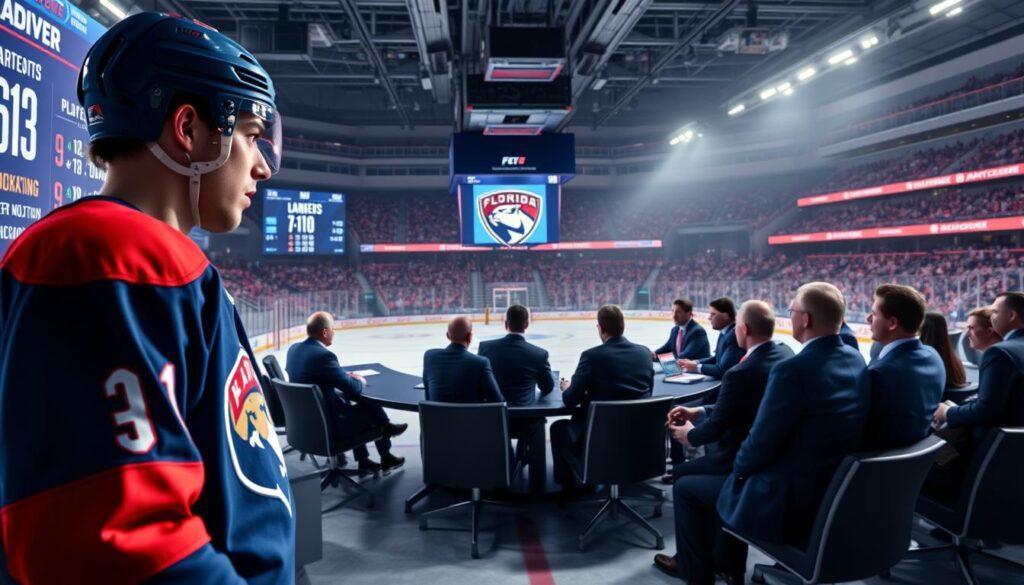
The real drama is inside the team. Players like Sam Bennett and Aaron Ekblad are free agents soon. Every game is a chance for them to show their worth.
Does a win against a top team convince Zito to spend big? Or does a loss make him wait until summer?
Zito has nearly $19 million in cap space. This is money to keep stars and add new players. He has to decide if to keep players or make a big move at the deadline.
Maybe the game shows the need for a tougher player or a better defenseman. Zito has shown he’s willing to act fast. The game’s outcome is key to his decision.
Watching the game is more than just enjoying the action. It’s seeing a business evaluation happen live. Every play by Bennett or Ekblad matters for their contracts.
So, as you watch, remember: the game is just the start. The real battle is for the team’s future. Zito’s decisions will shape the Panthers’ path, making every game a critical moment.
Playoff Race Positioning
While other teams fight for their playoff lives, the Panthers are focused on a different goal. They aim to optimize their path through the Eastern Conference bracket. The urgency has turned into strategy. For Florida, the goal is precision, not just survival.
Bill Zito has built a perennial contender. The Panthers aren’t just hoping to make the playoffs—they’re aiming for another Cup run. This changes how we view these late-season games.
What’s at stake tonight? It’s not just about making the playoffs. It’s about who they’ll face first. Every point matters for a favorable matchup.
Florida has a strategic choice to make. They can push for the divisional crown or settle for a top-three spot in the Atlantic. The former offers prestige, the latter might be easier.
Tonight’s game against [Opponent] is more than just two points. A win could separate them from a tough first-round foe. A loss might lock them into a less desirable matchup. This is where panthers hockey predictions get interesting.
What kind of opponent does Florida want? Their style suggests they prefer a speedy team or a physical rival. History shows one approach is better.
Let’s analyze with precision. If they secure the division, they face a wild card team. If they finish second or third, they get a divisional rival. Each path has its advantages.
The larger nhl game analysis shows something key. Florida’s success depends on their own execution, not just their opponent. When they’re on, they can beat anyone. When they’re off, anyone can beat them. The seeding just changes the difficulty level.
Tonight’s outcome shapes their entire postseason. Win, and they control their destiny. Lose, and they give up that control. For a team with championship dreams, every game is a statement.
The marathon continues, but the finish line is in sight. Florida’s playoff position will decide their path to the Final. The choices they make now will impact May and June.
Advanced Analytics Breakdown
Forget the highlight reel; the real story of this clash is written in expected goals and chance differentials. Welcome to the nerdy, beautiful world where NHL game analysis gets its PhD. We’re moving past the simple shot counter into the realm of what should have happened.
Take Gustav Forsling. His playoff numbers aren’t just good; they’re dominantly efficient. When he was on the ice at 5-on-5, the Panthers controlled more than 55% of scoring chances and 53% of expected goals. That’s not just winning shifts; that’s dictating the very terms of engagement. He’s a microcosm of why Florida is often an analytics darling.
But what do these terms mean? Let’s decode the jargon. Expected Goals (xG) assigns a probability to every shot based on location, type, and context. It tells us if a team is generating quality or just quantity. Corsi is simply shot attempt differential (shots, blocks, misses)—a proxy for possession. Then there’s High-Danger Chance Differential (HDCF), the holy grail for measuring who’s getting the gravy shots from the slot.
So, what do these metrics whisper about tonight’s matchup? Does the opponent’s xG consistently outpace their actual goal tally? If so, they might be a snake-bitten team due for positive regression—hockey’s way of saying “profoundly unlucky.” The Panthers’ stellar underlying numbers could hide a single, exploitable flaw. Are they vulnerable off the rush? Do defensive-zone face-offs become a black hole of possession?
This is where we separate compelling narrative from mathematical reality. A team can absolutely win a game while getting out-chanced. But ask any analyst: that’s a high-wire act, not a sustainable model. Elite teams dominate the underlying numbers, building a foundation of repeatable success. The analytics give us the “why” behind the final score.
Tonight’s NHL game analysis through this lens is critical. It tells us if a Panthers victory is built on rock or sand. It reveals whether the opponent’s record is a true reflection of their play or a statistical mirage. The numbers don’t lie, but you have to know how to listen to them.
Key Individual Battles
Hockey’s final score is a team statistic, but its story is told by individual battles. For a sharp florida panthers preview, we must look beyond the systems. We need to see the personal wars within the lines. Who wins these one-on-one clashes often decides the game.
Aleksander Barkov isn’t just a scorer. He’s a two-way player who controls the game. His battle against the opponent’s top center is a high-stakes chess game. Barkov will smother offensive rushes and win key faceoffs.
Can the other star outsmart Barkov’s defense? Or will Barkov’s quiet dominance control the game? This is the key to any panthers hockey predictions. If Barkov wins, Florida sets the game’s tempo.
The Agitator vs. The Reactor: Tkachuk’s Theater
Matthew Tkachuk, the master of chaos, targets the opponent’s most temperamental defenseman. Tkachuk’s game is a mix of skill and psychological warfare. He uses a slash after the whistle and words in the ear to get under his man’s skin.
The question is, who blinks first? If Tkachuk gets under his man’s skin, power plays will follow. This matchup is a key part of our florida panthers preview. It’s where emotion can override strategy.
The Silent Assassin: Reinhart’s Net-Front Office
While Barkov and Tkachuk get the spotlight, Sam Reinhart works in the shadows. His battle is against the opponent’s defense, finding the soft spot in coverage. Reinhart’s genius is his positioning.
His duel is a test of patience and precision. Can the defense box him out? Or will Reinhart quietly capitalize on a single mistake? This battle is often the difference in a one-goal game.
| Battle | Panthers Warrior | Key Style | Win Condition |
|---|---|---|---|
| The Cerebral Center | Aleksander Barkov | Two-Way Mastery | Neutralizing opponent’s top line; controlling possession. |
| The Chaos Agent | Matthew Tkachuk | Agitating Brilliance | Drawing penalties; disrupting defensive composure. |
| The Opportunist | Sam Reinhart | Net-Front Precision | Converting rebounds & deflections; capitalizing on power plays. |
So, how do these individual battles shape the final panthers hockey predictions? Simple. Florida needs to win at least two of these three duels. Barkov must be the best center on the ice. Tkachuk or Reinhart must tip a key moment in their favor.
Hockey is a team game, but it’s decided by individuals. Watch these spaces. The player who imposes his will here doesn’t just win a battle. He often wins the war.
Final Prediction & Betting Insights
After looking at every detail, the moment of truth is here. My predictions for the Panthers’ hockey game are based on their performance, tactics, and numbers.
This game is expected to be a defensive battle. Sergei Bobrovsky’s recent form and Florida’s strategy will play a big role. It’s likely to be a physical game with few goals. I predict Florida will win 3-1, showing their strength and discipline.