Do you remember the mid-90s? Grunge music was everywhere, the internet was slow, and the NBA saw a new blood feud. This rivalry wasn’t natural. It was created by corporate interests.
Pat Riley was the key player. He faxed his resignation from a beach, a move so cold it seemed like a scene from Shakespeare. His move from New York to Miami wasn’t just a job change. It was a betrayal that started the New York Knicks rivalry with Miami.
Riley’s decision added venom to the rivalry. Games became morality plays that fans couldn’t miss. Forget about Celtics-Lakers. This rivalry was personal.
The ’90s Knicks were all about hard work. The Miami Heat rivalry was about flashy South Beach style. The rivalry was more than just games and fights. It was full of drama.
Let’s go back and see how a betrayal created one of sports’ greatest stories.
The Scrums and Series: 1997–2000 classics
The late ’90s rivalry between the Heat and Knicks wasn’t just on the court. It was a battle of wills and strength. This time defined what a playoff series means to fans.
From 1997 to 2000, these teams clashed in the postseason three times. Each battle was a long, seven-game fight. The focus was more on survival than the game itself.
Imagine a war with a 24-second clock. Scrums on the bench and hard fouls were common. It was a game of wills, not just basketball.
Their dislike for each other was clear. It was like a heated political debate. This rivalry was more than a game; it was a fight for dominance.
One moment stands out. Jeff Van Gundy holding onto Alonzo Mourning’s leg in 1998. He looked like a dog defending its home.
This rivalry was all about getting the upper hand, no matter how. The series often came down to one heartbreaking shot.
Take Allan Houston’s game-winning shot in 1999. It bounced and rolled before falling through. That play showed how every shot mattered in these series.
Commentators said a random shot could change the game. When that happened, you knew it was going to be a long series. These battles always were.
This rivalry was about more than winning. It was about setting the tone for the conference. The Heat and Knicks were setting the standard.
Each series added to the tension. The rivalry grew stronger with each passing year. The legacy of those battles is felt in every modern matchup between these teams.
Tactical Evolution: Pace, spacing, switch schemes
Forget the flying elbows; the new war between Miami and New York is fought with spreadsheets, switches, and sublime spacing. The ’90s meat-grinder, where giants like Mourning and Ewing traded bruises in the paint, has been digitally remastered. Today’s clash is a high-definition chess match played at the three-point line.
This isn’t just a change in personnel. It’s a fundamental shift in basketball philosophy. The game’s economic center has moved from the low block to the perimeter. So, how do two franchises with deep, physical identities adapt? They don’t abandon their souls. They just write new code for them.
Enter Tom Thibodeau, the defensive cartographer. His Knicks are a symphony of controlled chaos. The system is built on a foundation of relentless physicality, but it’s now expressed through intelligent schemes. Hard hedges on ball screens force turnovers. A switch-everything mentality, with versatile forwards, aims to disrupt rhythm.
Thibodeau’s genius is making old-school grit analytically viable. He turns defense into a form of offensive attrition, grinding possessions into dust. The goal isn’t just a stop; it’s to drain the shot clock and force a desperate heave. It’s defense as a psychological weapon.
On the other side, Erik Spoelstra conducts an offensive kaleidoscope. If the Knicks weaponize friction, the Heat weaponize flow. Miami’s pace and spacing are a direct counter to New York’s grinding style. They don’t just run; they run with purpose, often looking to attack before Thibodeau’s defense can set its formidable jaws.
The Heat’s motion is constant—a hallmark of their vaunted Heat Culture. It’s a series of dribble hand-offs, pin-down screens, and sharp cuts designed to create microscopic advantages. Spoelstra’s system is the ultimate meritocracy of skill. It demands players who can read, react, and shoot. This approach is a perfect example of how modern offenses blend old-school tactics with new-age skills.
So, who wins the tactical duel? It’s a push-and-pull between two brilliant, opposing blueprints. The Knicks want to muck it up, lower the possession count, and win a street fight. The Heat want to spread you out, speed you up, and win a math test. This table breaks down the core clash:
| Team | Philosophy | Offensive Emphasis | Defensive Scheme | Key Metric |
|---|---|---|---|---|
| Miami Heat | Fluid, Intelligent Motion | Pace, Space, Player Movement | Versatile Switching, Aggressive Help | Effective Field Goal % |
| New York Knicks | Physical, Controlled Chaos | Offensive Rebounding, Post-Ups | Hard Hedges, Switch-Everything | Defensive Rating |
The beauty is in the adaptation. The Knicks use their physicality not to bully in the post, but to smother on the perimeter. The Heat use their intelligence not for complex plays, but for simple reads made at a blistering speed. This rivalry proves a point: in today’s NBA, your system is your star. And in the tactical lab of Heat vs. Knicks, we get to watch two master scientists test their very best formulas.
Star Power: Zo, LJ, Wade, Butler, Brunson—impact profiles
The characters in this clash have changed as much as the game itself. Rivalries are the stage, and the stars are the main actors. Their performances shape the lore.
Alonzo Mourning was more than a shot-blocker; he was a force field. His scowl warned opponents. Zo made the Heat tough, proud, and unyielding.
Larry Johnson was the ultimate counter-punch. His “Grandmama” persona was more than a gimmick. It was a way to disarm opponents before his strength overpowered them. His four-point play in 1999 is unforgettable.
Dwyane Wade brought electricity to the 2000s. His game was a mix of grace and power. Wade could change a game with one incredible quarter.
The 2000s brought a new type of player. Gone were the pure athletes. In came the skilled and strategic players.
Jimmy Butler is a modern star. He saves his energy for the playoffs. In the postseason, Butler becomes a fierce competitor. He scores, defends, and makes key passes.
Jalen Brunson plays with a different style. He’s efficient and scores at all levels. Brunson is the Knicks’ key player. He scores and creates for others with calm precision.
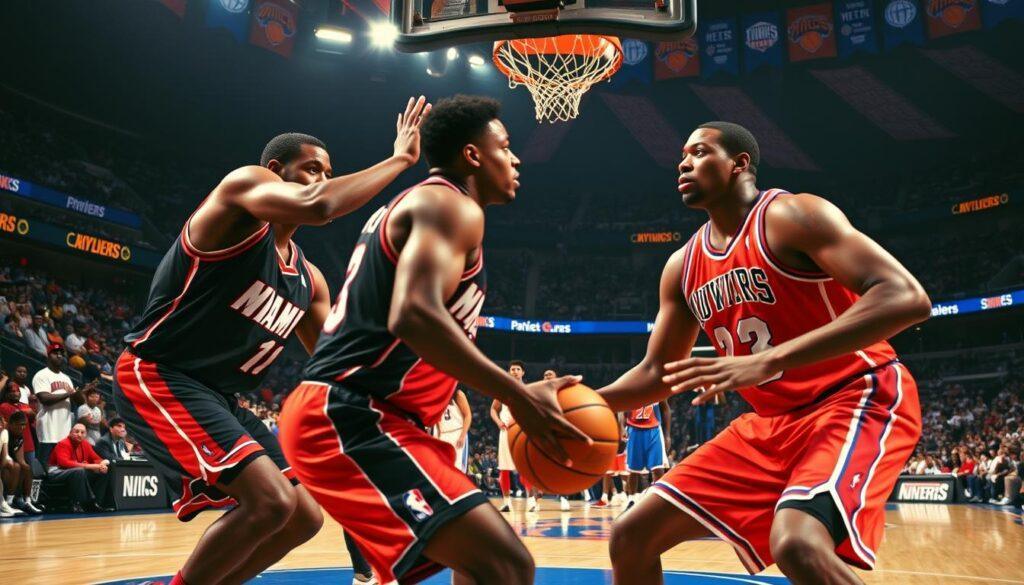
- Butler’s “Will It” Mentality: He thrives on chaos and physicality. His game is an assertion of force. He wants the moment to be messy, emotional, and decided by toughness.
- Brunson’s “Surgical Calm”: He seeks order and precision. His game is a series of calculated reads. He wants the moment to be clean, analytical, and decided by execution.
This clash is the rivalry’s new heartbeat. Jimmy Butler represents the Heat’s grit. Jalen Brunson is the Knicks’ disciplined star.
There are also wild cards. What if a former star makes a comeback? These subplots add depth to the main event.
In the end, Alonzo Mourning’s defense, LJ’s swagger, Wade’s grace, Butler’s fire, and Brunson’s ice are more than stats. They are the rivalry’s legacy. They define eras and decide games.
Coaching Trees and Culture Wars: Heat DNA vs Knicks grit
Pat Riley’s influence is huge in this rivalry. He created two different basketball cultures. The Heat is all about polish, while the Knicks focus on grit.
The Heat’s culture is all about hard work and defense. It’s like a military operation. Players are expected to do their part, not just show talent.
The Knicks, on the other hand, believe in raw effort and physicality. It’s a battle of wills on the court. They make every play a challenge.
These two philosophies started from the same roots. Riley was the foundation. Jeff Van Gundy and Tom Thibodeau followed his lead but went in different directions.
Miami focuses on the big picture, while New York is all about the emotional fight. One is a solid business plan, the other a call to action. Their games show this difference clearly.
| Aspect | Heat DNA | Knicks Grit |
|---|---|---|
| Core Philosophy | Professional System. The machine must run smoothly, regardless of the parts. | Emotional Will. The sum is greater than its parts through collective force. |
| Defensive Cornerstone | Accountability & Positioning. A choreography of switches and rotations. | Physicality & Contest. A mandate to body up and disrupt rhythm. |
| Player Development | Role Specialization. Find your niche within the system and excel. | Toughness Cultivation. Build mental and physical resilience above all. |
| Coaching Lineage | Pat Riley → Erik Spoelstra | Pat Riley → Jeff Van Gundy → Tom Thibodeau |
| Sustainable Advantage? | Yes, as a replicable system. But can it lack inspiration? | Yes, as an identity. But does it burn out its fuel? |
Is the Heat’s culture a lasting edge or just a buzzword? The evidence suggests it’s real. It makes teams perform better. But some say it hides talent issues.
Can the Knicks’ grit last long term? Thibodeau’s teams show it’s possible. But can it keep up over many seasons? The Van Gundy-era Knicks tried, but failed.
This rivalry is more than just games. It’s a debate between two basketball truths. Fans watch to see which philosophy will win out.
2012 and 2023 Renewals—how the matchup changed
The Heat-Knicks playoff series in 2012 and 2023 was like a TV show reboot that worked. It brought back the old magic with a new twist. The rivalry was like a show where the main character lives two different realities.
In 2012, the rivalry woke up again. It showed that the old hate was alive. The Miami Heat, with LeBron James, Dwyane Wade, and Chris Bosh, were the league’s top villains. The Knicks, led by Carmelo Anthony, were the underdogs from New York.
The story was simple: Goliath vs. David, but with more tattoos and trash talk. Miami’s athleticism and defense beat New York’s attack. The Heat won 4-1, but the rivalry was rekindled.
In 2023, the rivalry was reborn. It was no longer about superteams and underdogs. This time, it was a battle between two teams built for defense.
The Knicks had changed. They were no longer about Carmelo’s isolation. Instead, they had Jalen Brunson’s smart offense and defensive grit. The Heat had become a team of undrafted players and Jimmy Butler’s clutch shots.
The venues and uniforms were the same, but the game had changed. It was a physical battle of wills. The story was no longer about talent, but about will.
| Aspect | 2012 Playoff Series | 2023 Playoff Series |
|---|---|---|
| Heat Identity | Superteam Villains (LeBron, Wade, Bosh) | Culture & Grit (Butler, Adebayo, Role Players) |
| Knicks Identity | Star-Centric Underdog (Carmelo Isolation) | System-Based Contender (Brunson P&R, Defense) |
| Primary Narrative | Superteam vs. Underdog | Defense-First Contender vs. Contender |
| Series Outcome | Heat win 4-1 (First Round) | Heat win 4-2 (Conference Semifinals) |
So, how did the matchup change? In 2012, it was about stars colliding. In 2023, it was about systems clashing. The 2012 series was a look back. The 2023 playoff series showed the future of the rivalry—a tough, tactical, and personal battle.
The hate was no longer just about flashy headlines. It was in every defensive play, every box-out, and every clutch shot. The rivalry had grown up. It got smarter, tougher, and more compelling.
Analytics Corner: Shot charts, foul drawing, clutch time
Let’s dive into the numbers that fuel the Heat-Knicks rivalry. Emotions sell tickets, but data wins games. Every action on the court is tracked in today’s game. We’re moving from stories to algorithmic truth.
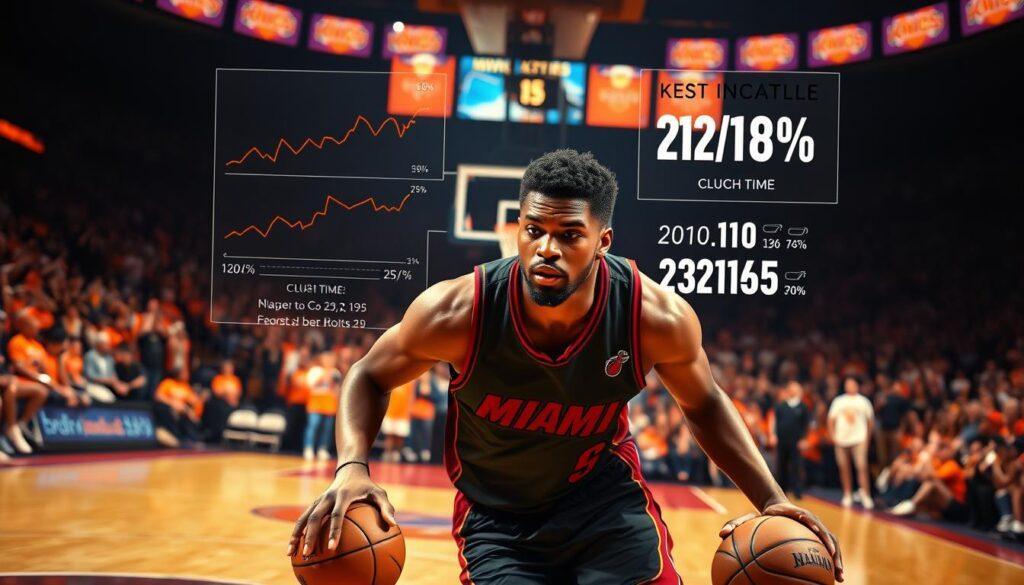
The Heat’s offense is a lesson in efficiency. They focus on the paint and corners, avoiding mid-range shots unless Jimmy Butler takes over. Their shot chart looks like a well-planned city, showing their strategy.
The Knicks, led by Tom Thibodeau, play differently. They shoot more from the three-point line and rely on Jalen Brunson’s skills. Miami’s defense forces the Knicks into these shots, making it a game of probability chicken.
The Free Throw Factory: Manufacturing Points
The free throw line is key in this physical rivalry. Who draws more fouls? It’s not that simple.
- Miami’s Artisan: Jimmy Butler doesn’t just draw fouls; he curates them. He leads the league in drives that end with a foul. It’s all about smart body control.
- New York’s Technician: Jalen Brunson uses his quick changes and underdog status to draw fouls. He gets the “and-1” calls that upset opponents.
Both teams are in the top ten in free throw rate. But Miami seeks contact, while New York initiates it.
Clutch Time: Where Legends Log Their Minutes
Now, let’s talk about the main event. “Clutch” means the last five minutes of a game within five points. This is where legends are made or broken. Let’s look at the two stars.
Jimmy Butler in clutch time is a phenomenon. He’s “extremely comfortable” in these moments. His efficiency spikes, making him one of the top closers today.
Jalen Brunson’s clutch performances are impressive too. He creates shots from nothing, like a step-back three or a floater. His confidence grows with the pressure.
| Metric | Jimmy Butler (Clutch) | Jalen Brunson (Clutch) |
|---|---|---|
| Points Per 36 Clutch Min | 41.2 | 38.7 |
| Field Goal % | 51.3% | 47.8% |
| Free Throw Rate | 52.1% | 45.6% |
| Assist-to-Turnover Ratio | 4.1 | 3.5 |
The table shows two different paths to success. Butler’s efficiency is unmatched, thanks to his free throw skills. Brunson’s playmaking keeps the Knicks in the game. Butler’s game is all about control, while Brunson’s is about creating space.
So, what does this mean for the next game? The data suggests that the team with the player who becomes the system will win. That’s usually Jimmy Butler and the Heat. But don’t count out the Knicks’ mathematician.
Madison vs Miami: Arena edge and fan narratives
If basketball arenas had personalities, Madison Square Garden would be a seasoned philosopher king. Miami’s home court is the charismatic club promoter. This isn’t just a New York Knicks rivalry or a Miami Heat rivalry. It’s a clash of environments, where home-court advantage turns into psychological warfare.
Madison Square Garden, the “Mecca,” is a cathedral of basketball. The energy when the Heat come to town isn’t just loud—it’s a physical force. You feel it in your chest. It’s a wall of sound built on decades of entitlement and a dose of desperate longing.
The crowd here isn’t just watching; they’re presiding. Every missed call is a personal affront. Every Knicks basket is a collective exhale of hope.
Contrast that with the vibe in Miami. FTX Arena, or whatever corporate name it holds this season, operates on a different frequency. It’s vibrant, flashy, and yes, the crowd might trickle in after tip-off. But when engaged, it erupts into a deafening, percussion-heavy frenzy.
It’s less a jury and more a party that suddenly turns ferocious. The Heat’s cool, disruptive confidence at home is a direct reflection of this atmosphere.
So, how do these spaces function as weapons? In New York, it’s the weight of history and amplified scrutiny. Opponents aren’t just playing five guys; they’re battling 20,000 critics with a PhD in every mistake. The Knicks’ “us against the world” ethos thrives here.
In Miami, the weapon is rhythmic disruption and swagger. The heat isn’t just on the court; it’s in the air, a humid confidence that can lull you before suffocating you.
The fan narratives are where the comedy and tragedy intertwine. Knicks fans wear their shared trauma like a badge—a generational sigh over near-misses and what-ifs. Their chants are pleas and demands. Heat fans, beneficiaries of more recent glory, project a relaxed certainty. Their hostility is cooler, almost amused, until the game tightens. Then the decibel level spikes.
Winning on the road in this series is the ultimate badge of honor. Silencing the Garden’s roar requires ice-water veins. Conquering Miami’s pulsating heat demands unwavering focus amidst the glamour. The table below breaks down this epic battlefield.
| Arena | Moniker & Vibe | Crowd Persona | Acoustic Signature | Home-Court Edge |
|---|---|---|---|---|
| Madison Square Garden | The Mecca; Hallowed, Pressure-Cooker | The Entitled Critic / The Desperate Believer | Deafening, sustained roar; orchestrated “DEFENSE!” chants | Imposes historical weight and intense scrutiny; amplifies opponent mistakes. |
| Miami’s Home Court | The Neon Lighthouse; Vibrant, Disruptive | The Chic Party-Goer / The Sudden Assassin | Percussive, rhythmic explosions; pulsating music during play | Creates a rhythm-disrupting, confidence-sapping environment; lulls then attacks. |
| Psychological Impact | Feels like a trial by a knowledgeable jury. | Feels like a battle in the coolest club where you’re not on the list. | Constant, judgmental pressure. | Erratic, swagger-filled bursts of noise. |
This duality defines the modern New York Knicks rivalry experience. Players talk about the difference in their post-game interviews. The energy is palpable in both buildings, but its flavor dictates the contest’s emotional rules. In one, you survive. In the other, you must dominate the vibe.
The Miami Heat rivalry, from the fan’s seat, is a study in contrasting loyalties. One fanbase guards tradition like a fortress. The other manufactures momentum in real-time. When these coliseums collide, basketball becomes a cultural anthropologist’s dream. You’re not just watching a game. You’re attending a clash of civic identities.
What to Expect Next Meeting: matchups and X-factors
Figuring out the next matchup between Miami and New York is more about strategy than luck. Their next game will be a test run for a playoff series. Every play will be a carefully thought-out move.
The spotlight will be on Jalen Brunson facing Miami’s tough defense. Jimmy Butler’s ability to control the game will also be key. The battle between Bam Adebayo and Julius Randle will be intense and interesting.
But don’t just focus on the stars. The real game-changers are often the players you don’t expect. Think of Steve Novak or J.R. Smith making big shots. These moments are what make this matchup special.
Who are the X-factors this time? For New York, OG Anunoby’s health is critical. He can disrupt Miami’s offense with his defense. For Miami, players like Caleb Martin or Haywood Highsmith could be the difference with their shooting and defense.
Injuries and the schedule can also change everything. A hurt star can flip the game plan. The timing and setting of the game add to the mental battle.
Momentum is also important. A team’s confidence can come from a win or a loss. Pride plays a big role in this rivalry.
This isn’t about making a prediction. Predictions are tricky. This is about understanding the game. Watch the Brunson-Butler matchup and see who guards whom. Look for Adebayo’s impact on Randle and who makes a big shot.
The next game is a test. It shows which team is toughest, can shoot well, and adapt. In a playoff series, these are the only things that matter.
Must-Watch Clips + Shareable graphics
How do you define a three-decade feud? Sometimes, the story is best told in pixels.
Our curated archive is your visual encyclopedia. Revisit the raw physicality of the late-90s brawls, a hallmark of the Pat Riley era. Watch Alonzo Mourning’s titanic clashes in the paint. Never forget Jeff Van Gundy’s desperate, legendary leg-cling—a moment of pure Van Gundy chaos.
Fast-forward to Dwyane Wade’s ballet at the rim, Jimmy Butler’s stone-cold takeovers, and Jalen Brunson dissecting defenses. These aren’t just highlights; they’re arguments settled.