The confetti from National Signing Day has settled. The transfer portal’s free agency period has closed. Now, the real work starts under the summer sun.
While pundits debate portal winners, we focus on the two-deep. This is the heart of a football team.
Welcome to the high-stakes, post-portal reality. Forget star ratings and NIL headlines. The real game is in the trenches and on the depth chart.
This isn’t about five-star recruits. It’s about who’s built to last.
We’re cutting through portal noise to examine Florida’s big six. Miami, Florida, Florida State, UCF, USF, and challengers are in focus. We’re not just listing names.
We’re grading roles—Starter, Rotation, Specialist. We’re pinpointing camp battles that will define the season’s start.
Forget the hype. This is a power map of the state’s gridiron landscape. We’re grading depth chart projections.
We’re naming under-the-radar freshmen and portal sleepers. They could swing an entire season. Let’s see who’s built for the long haul and who might be a house of cards.
Method: snap weight + coach tendencies + verified buzz
Predicting who will play in the transfer portal era is tough. It’s like trying to read a map in a hurricane. We’ve created a system that uses analytics, psychology, and a bit of spycraft. Forget the crystal ball; we use a method.
The “Snap Weight” Formula
We call it the “Snap Weight” formula. It’s a three-part system to predict playing time. It’s not about who should play, but who will play. It uses data, coaching habits, and gossip.
Think of it as your GPS for the post-portal depth chart. It removes guesswork by considering three key factors.
Film Grade + Practice Buzz + Historical Tendencies = Projected Role
Our “Snap Weight” isn’t just one number. It’s a mix of three factors, like a master bartender makes a cocktail.
- Film Grade: This is about what a player has done recently. It’s not just stats; it’s how they performed in real games. Did the new left tackle do well against a top SEC edge rusher? That’s a film grade.
- Coach Tendencies: This is the psychology. Does the new offensive coordinator love the two-back set? Does the defensive coordinator always start seniors over freshmen? A coach’s past predicts their future. We look at their history, not guess.
- Verified Buzz: This is our inside info. It’s the “verified” part that matters. Who is running with the first team in closed spring practices? Which transfer is impressing in practice? This isn’t rumors; it’s confirmed reporting from the field.
When you mix these three—Film Grade, Coach Tendencies, and Verified Buzz—you get more than a depth chart. You get a role grade. This isn’t just a depth chart; it’s a map for playing time. It shows not just who starts, but their role: a workhorse, a third-down specialist, or a red-zone weapon.
So, before we show you the two-deep for each Florida school, remember: the role grades aren’t guesses. They’re the result of a system designed to cut through the portal fog and tell you who will actually play this fall.
Miami Two-Deep with Role Grades
Miami’s depth chart is more than just a list of players. It’s a battle between new recruits and veterans. This shows Miami’s struggle between using transfer players and growing its own talent.
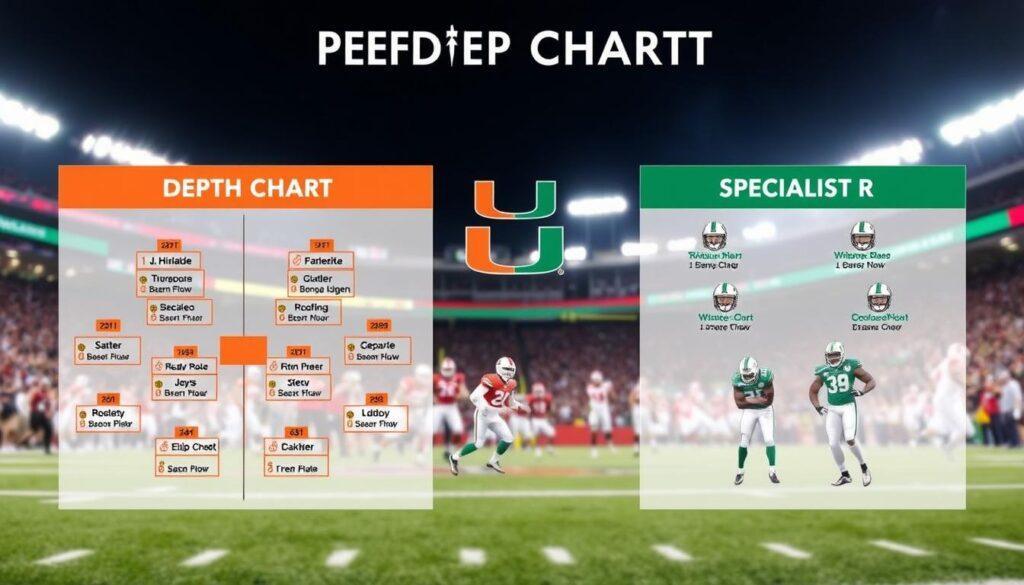
The Hurricanes’ two-deep is a living document of modern roster construction. It shows the power and danger of the transfer portal. A single injury or transfer can change the whole depth chart overnight. This is not just about listing names. It’s about the ongoing debate between keeping things the same and making quick changes.
Offense
The offensive two-deep shows a team in change, with a big question at quarterback.
Quarterback Conundrum
The QB room is a contrast. A veteran quarterback who knows the system is in a battle with a new player from the portal. This is not just about who plays. It’s about what kind of offense Miami will have.
Offensive Line Rebuild
The offensive line has a veteran transfer tackle but questions in the middle. A portal player and a young redshirt freshman are fighting for the right guard spot. The depth chart projections here are changing, with “OR” tags likely until September.
Wide Receiver Room
The outside receivers are fast, but the battle for the possession receiver is fierce. Three players are vying for the role of moving the chains on 3rd and 7.
Defense
Defensive coordinator Lance Guidry’s team has a solid core but needs help in the secondary.
Defensive Line Rotation
The defensive line is deep and strong. Four players could start for many top teams, making Miami’s pass rush a force to be reckoned with.
Linebacker Stability
The defense’s heart is solid. The starting linebackers are set, but the backup “Money” linebacker spot is up for grabs. A true freshman is making a strong case.
Secondary Shuffle
The secondary is where things get really interesting. One cornerback spot is secure, but the other and the nickel are up for grabs. The safety spot next to the All-ACC returnee is the most exciting battle in camp.
| Position | Starter (Grade) | Key Reserve (Grade) | Camp Battle / Notes |
|---|---|---|---|
| QB | Cam Ward, QB (Starter) | Tyler Van Dyke, QB (Rotation) | The most consequential battle. Ward’s arm talent vs. TVD’s experience. |
| RB | Donald Chaney Jr. (Starter) | Henry Parrish Jr. (Rotation) | Thunder and lightning. Chaney the bruiser, Parrish the home-run threat. |
| WR (X) | Xavier Restrepo (Starter) | Jacolby George (Rotation) | Restrepo is the alpha. George provides a different look in the slot. |
| LT | Jalen Rivers (Starter) | Matthew McCoy (Specialist) | Massive, veteran left side anchors the line. |
| CB | Daryl Porter Jr. (Starter) | Davonte Brown (Rotation) | Porter is the lockdown. The other side is a true battle. |
| SAF | Kam Kinchens (Starter) | James Williams (Rotation) | All-American safety leads a deep but unproven group. |
The true depth chart projections won’t be clear in July. They’ll be shaped in August, where small mistakes can change everything. The battles at boundary corner and the second safety spot will define this defense. On offense, the line’s right side and the third receiver role are competitions to watch. These depth chart projections are a glimpse of what could be. The real depth chart will be written on the practice field, one rep at a time.
Florida Two‑Deep with role grades
Miami is rebuilding fast, but Gainesville is taking a step-by-step approach. Billy Napier’s team mixes his recruits with portal players. This mix shows a long-term plan with quick fixes in key spots. Let’s look at the Gators’ two-deep, where the role grades show a team being built, not bought.
Offense: A Line in Flux, Skill in Bloom
The Gator offense is a blend of proven players and young talent. The biggest question is the line, but the skill spots are full of promise.
| Position | Starter (Role Grade) | Key Backup / Rotation | Role Grade |
|---|---|---|---|
| QB | Graham Mertz | DJ Lagway | Starter |
| RB | Montrell Johnson Jr. | Treyaun Webb | Starter |
| WR (X) | Eugene Wilson (Portal) | Andy Jean | Starter |
| LT | Damieon George Jr. (Portal) | Austin Barber | Rotation |
| RG | Knab <– CAMP BATTLE –> Lyndell Hudson | Christian Williams | Rotation |
The line is the main story. The left side, with Damieon George, is strong. The right guard spot is a battle, with no clear winner yet.
At the skill spots, Eugene Wilson is a big threat from the portal. He’s the X-factor. But the real interest is at QB. Mertz is the safe choice, but DJ Lagway has a high ceiling.
Defense: Stout Front, Shaky Corners
The front seven is strong, but the secondary has a big question.
| Position | Starter (Role Grade) | Key Backup / Specialist | Role Grade |
|---|---|---|---|
| Edge | Justus Boone | Princely Umanmielen | Starter |
| DT | Desmond Watson | Chris McClellan | Starter |
| LB | Shemar James | Mannie Nunnery | Starter |
| CB | Devin Moore | Jason Marshall Jr. | Rotation |
| CB | Jason Marshall Jr. | ??? (Camp Battle) | Specialist |
| Edge Rusher | T.J. Searcy | N/A | Specialist |
The front is fierce. Boone and Watson are the anchors. The second cornerback spot is a battle, with no clear winner yet.
T.J. Searcy is a Specialist for third-and-long. His job is clear, and his grade reflects that.
In Gainesville, the role grades show a team building through the lines and the portal. A few camp battles will decide the final two-deep. The foundation is strong, but the final shape depends on a tackle, a guard, and a corner.
Florida State Two‑Deep with role grades
Florida State is a mystery in the post-portal era. The team is made up of transfers and a new play-caller’s vision. Their two-deep is like a Rorschach test, showing how teams are built today.
The position battles in Tallahassee are intense. They might be the most exciting in the state.
Offense
The quarterback battle is the main story. It’s between a steady veteran and a dynamic transfer. This battle is not just about who plays but also about the offense’s identity.
The offensive line is a big question. Keiondre Jones could be the answer at right tackle. He’s expected to protect the quarterback well.
The skill positions are a mix of experience and new talent. This creates an interesting two-deep. It’s a constant battle between who has the most experience and who has the most promise.
| Position | Starter (Grade) | Backup (Grade) | Battle Intensity |
|---|---|---|---|
| Quarterback | Veteran Game Manager (Starter) | Dual-Threat Transfer (Rotation) | High |
| Running Back | Established Veteran (Starter) | Speed Back (Rotation) | Medium |
| Wide Receiver (X) | Boundary Threat (Starter) | Speedster (Specialist) | Low |
| Left Tackle | Portal Transfer (Starter) | Redshirt Freshman (Rotation) | Medium |
Defense
The defense is a mystery too. It’s a mix of five-star talent and unknown transfers. The pass rush has Cameron Williams, a specialist to get the quarterback.
The biggest position battle is for the starting nickel spot. It’s a fight between a seasoned veteran, a young athlete, and a versatile transfer. The winner will cover slot receivers in a pass-happy conference.
The defensive line is strong against the run but has edge questions. The linebackers are a mix of speed and experience, but depth is a concern. The “STAR” linebacker/safety hybrid spot is the most intriguing battle. The coaches are deciding between a run-stuffer and a coverage specialist.
This defense is built on talent and transfers. It could be surprisingly good or very bad, depending on the two-deep.
The position battles in Tallahassee will shape the team’s identity. Every practice is an audition for a team trying to prove itself.
UCF/USF Quick Two‑Deep Highlights
The Group of Five in Florida, often overlooked, is a hotbed for creative depth chart strategies. Here, the two-deep is more than just a list of names; it’s a statement of philosophy. Forget the five-stars; this is where finding a role and making a play is key. For UCF and USF, the two-deep reveals two programs in different rebuild phases. Every “Starter” and “Rotation” label is a high-stakes bet on their players’ abilities.
UCF Knights: The Gus Bus Reloads
Gus Malzahn’s offense in Orlando is all about speed. The Knights’ two-deep shows a team built to out-run and out-scheme opponents. It’s not about one star back; it’s about four receivers who rotate to keep the pace fast.
Defensively, the Knights’ two-deep at linebacker and in the secondary is intriguing. The “Knight” linebacker spot might have a shared starter label, making it a menu of specialists. The depth chart projections show a team ready for the Big 12: fast, deep at skill positions, and designed to out-scheme opponents.
UCF Knights: Projected Key Two-Deep
| Position | Starter (Projected) | Key Backup / Rotation | Note |
|---|---|---|---|
| QB | John Rhys Plumlee (Sr.) | Timmy McClain (Jr.) | Dual-threat veteran vs. strong-armed transfer. |
| RB | RJ Harvey (Starter) | Johnny Richardson (Rotation) | Harvey the hammer, Richardson the home-run threat. |
| WR (Slot) | Javon Baker | Kobe Hudson | Both will see starter-level snaps in 4-WR sets. |
| LB (Knight) | Walter Yates III | Quadric Bullard | This hybrid LB/S “Knight” position is the key to the 3-3-5. |
USF Bulls: The Alex Golesh Rebuild
In Tampa, the USF Bulls two-deep shows a program in the midst of a big change. The depth chart projections focus on who will step up, not just stars. The quarterback battle is key, with a seasoned transfer facing off against a talented freshman.
This is a depth chart in transition. The “Starter” at quarterback is a projection, not a certainty. The two-deep at wide receiver is fluid, and the offensive line’s second unit is a mix of transfers and redshirt freshmen. For Head Coach Alex Golesh, this two-deep is a to-do list for fall camp.
USF Bulls: Projected Key Two-Deep
| Position | Starter (Projected) | Key Backup / Rotation | Note |
|---|---|---|---|
| QB | Byrum Brown (So.) | Bryce Archie (Fr.) / Israel Carter (Fr.) | Brown’s experience vs. the freshmen’s promise. |
| RB | Nay’Quan Wright | K’wan Powell | Florida transfer Wright brings SEC size. |
| CB | Daquan Evans | Jarvis Lee (Fr.) | True freshman Lee as a primary backup signals a youth movement. |
| Edge | Jhalin Hobbs | Jacquez Williams | Pass rush is a major question mark; these two will rotate heavily. |
For both programs, the post-portal depth chart projections are less about naming a starting 22 and more about identifying the 30-35 players who will see the field. At UCF, it’s about maximizing a known system. At USF, it’s about finding the 22 most trustworthy pieces to begin the foundation. In the Group of Five, your two-deep isn’t a roster—it’s a survival kit.
Freshman/Portal Sleepers to Watch
While five-star recruits get all the attention, the real strength of a team often lies in the shadows. There’s a three-star gem or a transfer who will be key in a position battle by September. These players might not be at the top of recruiting lists but can change a season by October.
They are the true game-changers, turning spring practice stars into autumn heroes. These players are the ones who make a difference, not just the ones with the highest rankings.
The True Freshman Who Can’t Be Redshirted
Every year, some true freshmen are too good to sit on the bench. Their talent is undeniable, forcing coaches to play them right away. A 6’5″, 245-pound tight end at Florida is a perfect example. He’s already dominating in run-blocking, making him a red-zone threat from day one.
His ability to seal the edge in run games means he’ll play more than just in passing situations. By fall, he won’t just be a specialist; he’ll be a starter.
The Portal Steal No One is Talking About
The real game-changers are often the quiet ones, not the flashy five-star transfers. A three-star linebacker at Florida State is a prime example. He’s a former quarterback with incredible athleticism, making him a game-changer on defense.
He’s a “Rotation” player now, but his film shows he has a natural feel for the game. He diagnoses plays like a quarterback and tackles with the force of a safety. By November, he might not just be in the position battle for a starting role; he’ll have won it.
These players are the chess pieces that win position battles in the SEC and ACC. They’re the reason a two-deep is always changing, not static. The three-star portal addition or the freshman tight end with a tackle’s frame can make all the difference.
As one coach said, “The portal giveth, and the portal taketh away, but the kids who work in the dark are the ones who own the fourth quarter.” Keep an eye on these players. By mid-season, they won’t be secrets anymore.
Bubble Battles Camp Will Decide
Spring practice is for starters. Fall camp is for finishers. The depth chart in May is just a theory. But the one in late August is real, tested in battles.
The most intense competition doesn’t get the headlines. But it defines a season. While we focus on the starting QB, the real team soul is forged in these battles. A Specialist role can change a game.
These duels keep coaches up at night. The difference between a Starter and a Rotation tag is a single missed assignment. It’s not just about the first name on the sheet.
It’s about the 65th scholarship player versus the 66th. The special teams demon, the third-down pass rusher. These are the bubble battles.
The Punter is Also the Backup QB?
This sounds like a gimmick, but it’s real. The era of the specialist-only punter is fading. Now, teams want athletes.
The battle for the punter job is more than hang time. Can the punter also be the emergency QB? Does he have the athleticism for trick plays?
A team might carry a “specialist” kicker. But they’re looking for a weapon. The battle is between a traditional punter and a versatile athlete. The role grade is “Specialist (Weapon).” It’s about who brings more to the roster in a pinch.
The Third-Down Nickel Spot
This is where modern defense is won or lost. On first and second down, you want your run-stuffing end. But on 3rd-and-6, you need a different animal.
The battle for the “third-down pass rusher” role is a clash of archetypes. You have the veteran specialist with a single, devastating spin move. Or a more versatile but less explosive athlete. Does the coach want a one-trick pony or a flexible player?
This battle, fought on the fringes of the depth chart, will decide who gets the call when the game is on the line.
Beyond the glamour positions, these bubble battles rage. In the slot, a savvy senior is being pushed by a portal transfer with 4.3 speed. The kick returner battle is a three-horse race.
Each of these battles will be settled by a single play in camp. A muffed punt, a perfect jam at the line, a shoestring tackle on a kickoff. These aren’t just roster spots being won. These are the role grades being inked in pen, the final brushstrokes on the two-deep that will run onto the field in September. They are the camp battles that, in the end, define a team’s identity and depth.
September Readiness Scorecards & Update Plan
The August sun is heating up the practice fields. Our two-deep lineup is just a starting point. We’re diving into readiness, asking how each unit is set for the season’s start. Our readiness scorecards and update plan are ready to track these changes.
Readiness Scorecard: Offense, Defense, Special Teams
It’s not just about the roster. We’re grading each unit’s readiness. Imagine a pre-season physical for every position group. We’re checking on Miami’s offensive line, Florida’s secondary, and FSU’s pass rush.
Each unit gets a readiness score. This turns our static depth charts into dynamic preseason physicals.
The In-Season Update Protocol
The first update comes with the fall camp depth chart. This is when our projections meet reality. We’ll look at the gaps, surprise starters, and players who won camp battles.
The first depth chart is just the start. Our system tracks August’s changes—like injuries and transfer portal moves. This ensures our depth charts stay up-to-date all season.
Rosters change, and so will our analysis. If a new two-deep emerges or a key player leaves, we’ll explain why. We’ll follow every step of the season.