Forget the final score for a moment. What happens on the first Saturday in November in Jacksonville is more than a football game. It’s an annual, genteel Southern secession.
Two fan bases, divided by a river and a century of spite, meet on a neutral site. They gather for what’s called the “World’s Largest Outdoor Cocktail Party.” The bourbon flows, the seersucker is pressed, and beneath the civility simmers a cold war for SEC East supremacy.
Think of this annual Jacksonville showdown as geopolitical theater. A single play here can change a decade of bragging rights and alter recruiting maps. For the analytically minded, it’s a masterclass in coaching dogma clashing in real time.
We’re here to autopsy the turning points. To decode the scheme wars between the Gators and Bulldogs. To explain why, when the clock hits zero, half the city smiles while the other half plots very quiet, very Southern revenge. Strap in.
Rivalry Origins and Why Jacksonville Matters
Jacksonville isn’t just a backdrop; it’s the rivalry’s third character, a neutral arbiter with a cocktail in hand. Think about it. In a sport where home-field advantage is a sacred, statistical truth, the Florida-Georgia game is a glorious aberration. They meet in a shared, sun-baked port city, turning a blood feud into a bizarre annual convention. This Jacksonville neutral site arrangement is college football’s most fascinating diplomatic experiment.
The origin story reads like a pragmatic peace treaty. In the 1930s, travel was a beast. Meeting halfway in Jacksonville simply made logistical sense. But the genius wasn’t in the mileage. It was in the psychology. By removing the true 12th man—the deafening home crowd—you create a vacuum. In that vacuum, pressure doesn’t dissipate. It condenses. Every mistake echoes in a stadium equally filled with cheers and groans.
So, does playing in this vacuum amplify pressure or reveal a team’s true character? The answer is both. Without the crutch of familiar sights and sounds, fundamentals get exposed. A quarterback’s poise is tested not by noise, but by silence. A defense’s communication is laid bare. The Jacksonville neutral site becomes a 60-minute personality test. Some teams crack under the sterile pressure. Others treat it like a blank canvas.
This brings us to the famous moniker: “The World’s Largest Outdoor Cocktail Party.” It’s not just marketing. It’s a tactical confession. The party is a necessary pressure valve. Fans from both sides mix in a way that’s unthinkable in Athens or Gainesville. They unite in celebration before dividing in competition. This unique atmosphere, as one source notes, brings communities together before the game pulls them apart. The tailgates are legendary because they have to be. They soften the edges of a game played on neutral ground.
For the SEC East, this game has long been the de facto championship gatekeeper. More often than not, the winner in Jacksonville books their ticket to Atlanta. The neutral territory adds a cruel fairness to this process. There’s no blaming a hostile environment. The better team, on that day, in that vacuum, usually wins. This has shaped the entire dynamic of the division for decades.
The choice of Jacksonville was logistical first. Its impact, though, is profoundly psychological. It transformed the rivalry from a home-and-home series into a standalone event. A spectacle. The city itself—a neutral port—forces a purity of competition you rarely see. It explains why momentum swings in this game feel so violent and decisive. There’s no home momentum to fight against. When a wave starts, it crashes over everyone equally.
In the end, the SEC East title often runs through this neutral city. The quirky location deal, struck for simple reasons, created a complex and perfect crucible. It strips away excuses and highlights character. The scoreboard in Jacksonville doesn’t just show who won a football game. It often reveals who handled the strange, pressurized silence of a home that belongs to no one.
Coaching Eras: Spurrier to Smart—identity shifts
The change from Steve Spurrier’s bold offense to Kirby Smart’s defense is huge. It’s like a change in movie genres. The whole story feels new.
Steve Spurrier didn’t just coach; he put on a show. His Fun-‘n’-Gun offense was a bold statement. The visor toss was a symbol of his disdain for defense.
For Spurrier, beating Georgia was a clever trick. He used quarterbacks like pens and the end zone as his conclusion. His team was flashy, confident, and overwhelming.
Now, Kirby Smart coaches like a chess master. He doesn’t ignore emotions but channels them through a strict system.
Smart’s era is about detailed plans and algorithms. He aims to show his opponents’ flaws. It’s not just about winning.
Spurrier’s game was all about the mind game. Smart’s is about perfect execution. One loved the explosive plays. The other wants to control every detail.
This change reflects football’s evolution. We’ve moved from creative coaches to strategic ones. Spurrier was like a jazz musician, improvising. Smart is a conductor, ensuring every detail is perfect.
Spurrier’s Gators were the exciting, maddening heroes. Smart’s Bulldogs are the unstoppable force. The game remains the same, but the approach is vastly different.
Signature Games Timeline and Turning Points
Forget the final score. The true story of the Cocktail Party is in the three seconds of a team stomping on a logo. History here isn’t measured in years, but in specific, seismic plays. Everyone in the stadium remembers where they were.
We’re talking about the hinge-points. The single call, the missed tackle, the fourth-down gamble that calcified into lore. These are the moments where coaching strategy met player fate, and the result was legend.
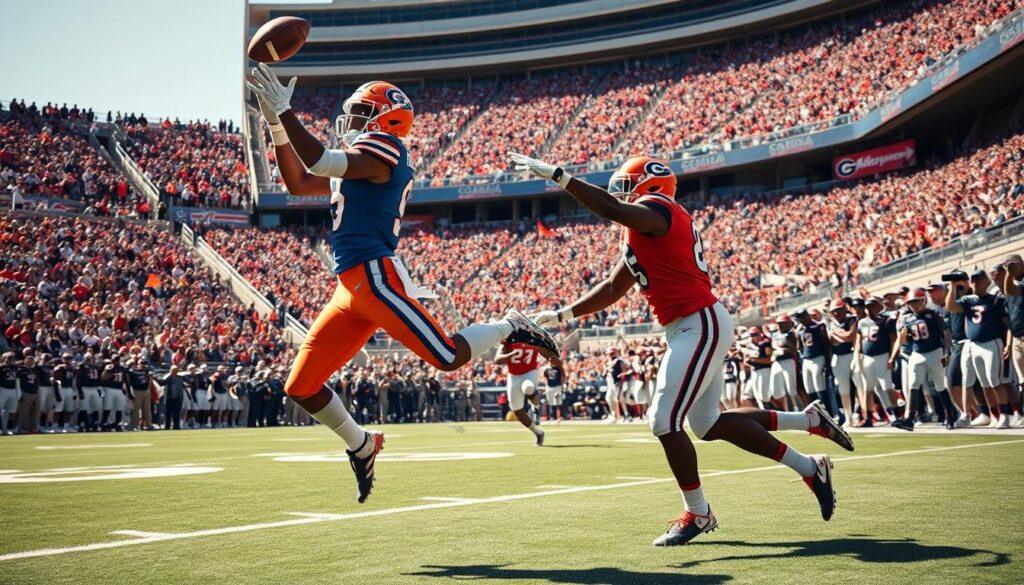
| Year | Final Score | The Turning Point Play | Immediate Impact | Long-Term Lore |
|---|---|---|---|---|
| 2007 | UGA 42 – UF 30 | The “Gator Stomp” team celebration in the end zone after UGA’s first TD. | Psychic shockwave. Georgia played with unleashed, emotional fury. | Cultural reset. Defined Mark Richt’s “finish the drill” era and shifted rivalry’s psychic weight. |
| 1995 | UF 52 – UGA 17 | Danny Wuerffel’s 99-yard TD pass to Chris Doering on a broken play. | Broke the game open before halftime; showcased Spurrier’s “Fun ‘n’ Gun” at its peak. | Became the iconic highlight of Florida’s 1990s dominance. A symbol of explosive, demoralizing offense. |
| 1980 | UGA 26 – UF 21 | Buck Belue’s 93-yard game-winning TD pass to Lindsay Scott on 3rd & long. | Saved Georgia’s undefeated season and national title hopes in the final minutes. | “Run, Lindsay, Run!” The radio call is immortal. Cemented Herschel Walker’s legend en route to a championship. |
| 2015 | UF 27 – UGA 3 | Antonio Callaway’s 66-yard punt return TD, a momentum-swinging trick play. | Turned a defensive slog into a Florida rout, sealing the SEC East for the Gators. | Marked the high point of the McElwain era. A rare special teams game-changing play that defined a season. |
| 2020 | UF 44 – UGA 28 | Kyle Pitts’ 25-yard TD catch over double coverage on 4th down in the 2nd quarter. | Announced Florida’s offensive evolution under Mullen. A statement of schematic defiance. | Symbolized the brief shift to a pass-heavy, “Air Raid” identity in the rivalry, challenging UGA’s defensive DNA. |
The 2007 “Gator Stomp” is our prime exhibit. It wasn’t a spontaneous celebration. It was a calculated act of disrespect, orchestrated by Coach Mark Richt. The Xs and Os were simple: score, then gather. The psychology was complex.
By having the entire team rush the end zone, Georgia didn’t just score six points. They declared the Florida logo neutral territory. They absorbed a penalty and transformed it into pure motivational fuel. The ensuing 42-30 upset wasn’t just a win. It was a psychic takeover.
Other rivalries have blowouts. This one has inflection points. Was 1995’s 99-yard pass a brilliant improvisation or a coverage bust? Both. It was the moment Steve Spurrier’s system proved it could manufacture points from chaos.
And 1980? Lindsay Scott’s run was the ultimate hinge-point. One missed tackle by a Florida defender, and an entire season’s destiny changed. That’s the thin margin we’re analyzing.
These legendary moments share a DNA. They occur when preparation meets opportunity, and someone has the audacity to seize it. They’re the plays coaches draw up in desperation that become immortal. They’re the tackles that, if missed, haunt a fanbase for decades.
So, when you watch the next installment, don’t just watch the scoreboard. Watch for that one sequence. The fourth-down gamble. The trick play on special teams. The coverage decision on a star tight end. That’s where the next chapter of the timeline gets written.
Scheme vs. Scheme: Run fits, RPOs, pressure packages
Georgia’s defense doesn’t just tackle; it solves equations. Florida’s offense doesn’t just run plays; it sets traps. This is the cerebral core of the Cocktail Party, a rivalry that has evolved from a slugfest into a grandmaster’s chess match.
Forget the mascots. Let’s talk math. The modern iteration pits a defensive scheme built on algorithmic precision against an offensive scheme designed to create chaos. It’s order versus entropy, played out on a 100-yard grid.
The foundation of Georgia’s dominance is its run fits. This isn’t just tackling the guy with the ball. It’s a synchronized ballet of gap responsibility. Each defender has a specific lane, a specific assignment. The beauty is in the discipline.
Florida’s spread attack, on the other hand, is engineered to crack that discipline. They use tempo, formation, and most importantly, the Run-Pass Option (RPO). The RPO is the ultimate stress test for a perfect run fit. It turns a defender’s read into a guessing game with a .5-second time limit.
Do you crash down to stop the run? The quarterback pulls the ball and hits a receiver in the space you just vacated. Do you stay in your pass coverage lane? The running back takes the handoff and gallops through your gap. It’s a brutal binary choice.
So how does Georgia counter? With disguise and controlled violence. Enter the “Jack” linebacker. This hybrid player is the Swiss Army knife of the pressure package. Is he rushing? Is he dropping into coverage? The offensive line has no idea until the snap.
This disguise extends to the secondary’s coverage shells. That look like Cover 2? It might rotate to Cover 3 at the snap. The goal is to bait a young quarterback into a throw he thinks is safe, only to have a defender appear from nowhere. It’s football’s version of a magic trick.
The counter-adjustments are where coaches earn their millions. Florida might answer a heavy pressure package with a “now” screen or a quick tunnel screen. It turns Georgia’s aggression against itself. These moments look like coaching genius, but they’re just the next move in a pre-planned sequence.
Let’s break down this tactical arms race into a digestible playbook. The table below contrasts the philosophical and practical approaches that define this matchup.
| Tactic | Georgia’s Defensive Approach | Florida’s Offensive Counter | Key Player/Concept |
|---|---|---|---|
| Run Fits | Gap-sound, disciplined, swarm tackling. Each player “fits” into his assigned gap like a puzzle piece. | Use of zone-read and outside zone to stretch gaps horizontally, forcing defenders to choose. | Defensive tackles maintaining “A-gap” integrity; Florida’s pulling guards. |
| RPO Defense | “Conflict” defenders are trained to read the offensive tackle’s block. Post-snap decision-making is key. | Mesh concepts and bubble screens attached to run plays. Stress the edge defender’s eyes. | The Star/Nickel defender. His read determines the success of the entire play. |
| Pressure Packages | Simulated pressures (3-man rush with 2 blitzers). Disguise the fourth and fifth rushers. | Hot routes and sight adjustments for the QB. Quick-game passing to punish the blitz. | The “Jack” linebacker (Nolan Smith, Jermaine Johnson archetypes). |
| Coverage Shells | Pre-snap disguise, post-snap rotation. Bait quarterbacks into throwing windows that close. | Pre-snap motion to identify coverage. High-Low reads on safeties to beat rotation. | Free safety reading the QB’s eyes; Florida’s slot receiver running option routes. |
Watching this game, the real drama isn’t always at the point of catch. It’s in the offensive line’s first step. It’s in the linebacker’s slight shuffle before the snap. It’s in the quarterback’s eyes, darting from a key defender to an open window.
This is for the fan who watches the guard, not the ball. You’re not just seeing a game. You’re witnessing a real-time autopsy of football intelligence. The run fits, the RPOs, the pressure packages—they’re the language of modern warfare. And in Jacksonville, they write the most compelling chapters.
QB Play Through the Years: Efficiency vs explosives
For decades, the duel between Florida and Georgia QBs has posed a fundamental football question: is it better to be a surgeon or a sorcerer? The surgeon operates with cold precision, dissecting defenses with methodical reads and safe throws. The sorcerer deals in chaos and lightning, turning broken plays into legendary highlights. In Jacksonville, this isn’t just a style choice. It’s a philosophical war that defines eras.
Let’s chart the archetypes. On one side, you have the calculated pocket passer. Think Chris Leak or Aaron Murray. Their game was about ruthless efficiency. Don’t turn the ball over. Convert third and manageable. Manage the game like a CEO managing a quarterly report. It’s effective, often brilliant in its boringness. But does it win the big one?
On the other side stands the dual-threat chaos agent. Tim Tebow is the patron saint here, but think also of D.J. Shockley or the fleeting, terrifying presence of a player like Justin Fields. Their mandate is different. Create explosives. Extend plays. Make something from nothing. It’s high-risk, high-reward theater. It gives fans heart attacks and defensive coordinators night sweats.
Which philosophy has owned the Cocktail Party? The data tells a messy story. The surgeon’s approach delivers consistency. It keeps your team in the game, avoids the catastrophic mistake that swings momentum in a hostile, neutral-site environment. But the sorcerer delivers the iconic moment—the play that lives forever on highlight reels and in rival taunts.
Consider the pressure cooker. The Jacksonville crowd is a split, roaring entity. For a quarterback, every snap feels like a referendum. The efficient manager can thrive here by ignoring the noise. The chaos agent can weaponize it. I’ve always thought the game rewards the one who can bend the environment to his will, not just survive it.
Look at the record books. Georgia’s recent dynasty under Kirby Smart has been built, in part, on efficient, game-managing quarterback play. Stetson Bennett was the ultimate embodiment. He wasn’t there to throw for 400 yards. He was there to not lose. And it worked. Florida’s most dominant modern run, on the other hand, was powered by Tebow’s sorcery—a brutal combination of power runs and deep-shot faith.
So, who wins? Let’s break down some of the most telling quarterback performances in the rivalry’s modern history. The table below isn’t about career stats. It’s about the archetype in action during the game that matters most.
| Era | Florida QB (Archetype) | Georgia QB (Archetype) | Defining Metric | Game Outcome & Legacy |
|---|---|---|---|---|
| Mid-2000s | Chris Leak (Surgeon) | D.J. Shockley (Sorcerer) | Leak: 0 INT, 70% comp.; Shockley: 100+ rush yds, 1 TD | UF win (2005). Efficiency weathered the storm of Shockley’s explosiveness. |
| Tebow Era | Tim Tebow (Sorcerer) | Matthew Stafford (Gun-Slinger) | Tebow: 5 Total TDs (2008); Stafford: 300+ pass yds | UF blowout wins. Sorcery utterly overwhelmed pure passing talent. |
| 2010s Trench War | Treon Harris (Game Manager) | Aaron Murray (Surgeon) | Murray: 400+ pass yds, 0 turnovers (2013) | UGA win. A surgeon’s masterpiece in a losing season for UF. |
| Modern (2020s) | Anthony Richardson (Sorcerer) | Stetson Bennett (Surgeon) | Richardson: 80-yd TD run; Bennett: 0 INT, 2 TD | UGA wins. The surgeon’s system beat the sorcerer’s sporadic magic. |
The pattern is clear, but the conclusion is nuanced. The surgeon’s method has a higher floor. It gives you a chance every year. The sorcerer’s method has a higher ceiling. It can produce dynastic, era-defining dominance. When a sorcerer is on, he’s unbeatable in this setting. But when he’s off, the mistakes are magnified.
This brings us to the final score and situational context. A quarterback’s legacy in this rivalry is often sealed by one drive, one throw. The efficient QB hopes to engineer that drive. The explosive QB aims to erase the need for it with one swing. In recent years, the surgical approach has claimed more trophies. But ask any fan which plays they remember—it’s the sorcery every time.
So, does the Cocktail Party reward the surgeon or the sorcerer? It rewards the winner. And the winner, more often than not, has been the quarterback who best understood the day’s required recipe. Sometimes it’s a slow, precise simmer. Sometimes you need to blow the lid off the pot. The great ones, the star quarterbacks who change dynamics, have a little of both in their soul. They just choose the right mask for the Jacksonville masquerade.
Advanced Stats: Success rate, EPA, field position trends
The box score is for those who love the past. For those who seek truth, we dive into EPA and success rates. Numbers are cold and often tell us who will win before the game ends.
We’re moving beyond just yards and touchdowns. We’re into Expected Points Added (EPA). It’s like a financial score for each play. A 3-yard run on 3rd & 2 is great. But the same gain on 3rd & 8 is bad.
Success Rate is simple: did the play keep the offense moving? Gaining 50% of needed yards on first down is good. On second down, 70% is better. On third or fourth down, 100% is best. Keep doing this, and you win.
- Expected Points Added (EPA): The net point value of a play based on down, distance, and field position. Positive is good. Very positive is a touchdown.
- Success Rate: The percentage of plays that are “successful” in maintaining offensive momentum. It’s the heartbeat of a drive.
- Field Position: The silent assassin. Starting a drive at your own 10 versus the opponent’s 45 is the difference between climbing a cliff and rolling down a hill.
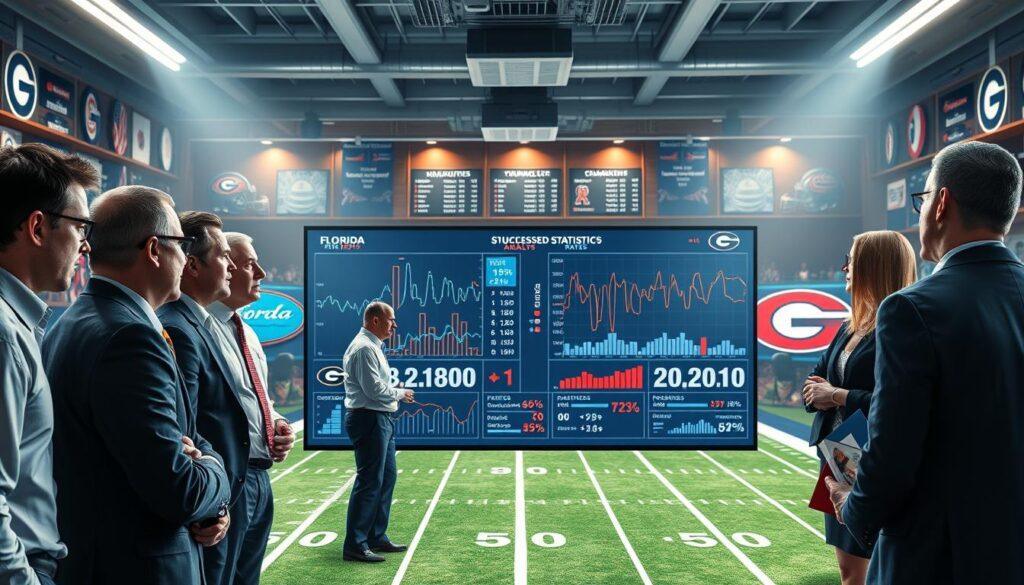
Does winning the rushing EPA battle usually win the Cocktail Party? Almost without fail. It’s not about who has the most rushing yards. It’s about which team’s runs create more scoring chances. Georgia’s recent dominance shows this well.
Georgia’s offensive line makes runs that create positive EPA on standard downs. This forces Florida into predictable passing situations. When Florida’s run game has a negative EPA day, their offense fails. The team that controls the ground game’s math controls the game’s emotional arc.
The down-and-distance trend that decides games? Look at Success Rate on 3rd & medium (4-6 yards). This is the rivalry’s true pivot point. It’s the distance where playbooks open up, but pressure is highest. A high success rate here doesn’t just move chains; it demoralizes a defense and drains the clock. Over the last five meetings, the winner has owned this specific situation more than 70% of the time. It’s the statistical equivalent of a body blow.
| Statistical Category | Florida Avg. (Last 5 Meetings) | Georgia Avg. (Last 5 Meetings) | Key Insight |
|---|---|---|---|
| Rushing EPA/Play | -0.08 | +0.12 | Georgia’s consistent positive value is a massive separator. |
| Success Rate on 3rd Down | 38% | 47% | Nearly a 10-point gap. Georgia stays on schedule; Florida faces more 3rd & longs. |
| Avg. Starting Field Position | Own 27-yard line | Own 35-yard line | An 8-yard hidden advantage for Georgia every single drive. |
| EPA/Pass on 1st Down | +0.15 | +0.22 | Georgia is more efficient and explosive on the most predictable passing down. |
Field position is the stealth metric. That eight-yard average starting field position difference is a silent, cumulative poison. Over ten drives, that’s an extra 80 yards of territory Georgia doesn’t have to earn. It forces Florida to be perfect in long fields, while Georgia can play for field goals and punts that flip the field again. It’s a grinding, statistical stranglehold.
So, what’s the one metric Kirby Smart and Florida’s coaches are truly obsessing over? It’s not total offense or time of possession. It’s EPA per play on standard downs (1st & 10, 2nd & short-medium). Win the early-down efficiency battle, and you dictate the entire game script. You create manageable third downs. You open the play-action game. You force the other team to abandon their identity. In this rivalry, data is the new whiskey at this cocktail party—the stronger, more intoxicating truth behind the splash plays and the heartbreak.
Game-Day Atmosphere: Tickets, tailgates, travel tips
This isn’t just a travel guide. It’s a guide for diving into the World’s Largest Outdoor Cocktail Party. The game is just the climax of a three-day event where Southern culture meets college spirit. You’re on a mission to blend in like a pro and observe like an anthropologist.
First, know the territory. The tailgates are divided. For the cool, knowledgeable fan, head to the south lots near the stadium. Here, you’ll find setups passed down through generations, deep cigar talks, and fine bourbon. The conversations are as classy as the drinks.
On the other hand, the fraternity blowout zones spread out from the stadium. These areas are known for their beer pong, loud music, and fun. It’s great for watching people, but it might be too much for your ears and liver. Pick your spot based on how much excitement you can handle.
Tickets can be tough to get. You don’t need to take out a loan, just be smart. The primary market sells out fast. You’ll need to buy from the secondary market, but be quick. Prices drop a bit 36-48 hours before the game. Set up alerts and be ready to act fast. Also, remember, a single ticket to a big game is a unique experience. Go with it.
Traveling to and around Jacksonville during the game is a challenge. The city gets very crowded. Here are some tips:
- Parking: Book a spot in a private lot or garage downtown. Walking there is part of the fun. Stadium parking is rare for regular fans.
- Rideshares: They’re not the best option after the game. Plan to walk or have a designated driver. The prices can be high.
- Accommodations: If you didn’t book early, consider staying in the beaches area or across the river. The ferry is a nice, less crowded way to get there.
Lastly, your cultural kit is important. It’s not just about what you wear, but what you bring and how you act. Bringing a good bottle of bourbon is a sign of respect in the veteran tailgates. It’s like a special pass. For the best views, stand where different fan groups meet. Watch the outfits and listen to the banter.
The Cocktail Party is more than just a game. It’s about the small details that make it special. Mastering these details turns you from a spectator to a part of the tradition.
Media Moments and Fan Lore
If you think the Florida Georgia rivalry is just about football, you’re missing the magic. The touchdowns and interceptions are just the start. It’s the quotes and legends that really set the fire ablaze.
Steve Spurrier didn’t just beat Georgia; he narrated their demise with a smirk. His quips were more than insults. They were a form of psychological warfare, making the Gators vs Bulldogs feud a battle of wits as much as wills. You can almost hear the smirk when he’d mention “that school out east” or their “woeful” defensive schemes.
These media moments do more than fill column inches. They crystallize the animosity for fans. A player’s boast or a coach’s dry barb becomes a battle cry or a grievance to be avenged. It turns a game into a chapter in an ongoing saga of glorious pettiness.
Then there’s the fan lore. This is the stuff you won’t find in any official record. It’s the apocryphal tale of the friendship shattered by a lost bet on the 2008 game. It’s the bizarre, scientifically dubious superstition about wearing the same faded jersey for every win.
My personal favorite? The deeply held belief in certain circles about a cursed uniform combination. Wear the wrong pants with the wrong helmet in Jacksonville, and you’ve doomed your team. It’s nonsense, of course. But it’s the sacred nonsense that binds generations of fans together.
These stories are the real glue of this rivalry’s culture. They’re the shared and divisive narratives that turn a community into a tribe. On Monday, the “miserable and evasive” half of the office has its story of the jinx. The gloating half has its legend of the prophetic tailgate ritual.
The Florida Georgia rivalry thrives in this space between fact and folklore. For more on the hard facts of the gridiron, dive into this collection of the best moments in the Florida Gators vs. Georgia Bulldogs. But remember, the stories told in the stands and the bars are what make those moments eternal.
What to Watch Next Season (Key Matchups/Returns)
Predictions are for amateurs. Focus is for die-hards. Here’s exactly where to train your binoculars when the teams run onto the field in Jacksonville.
The final score is just math. The real story unfolds in a few critical, one-on-one chess matches. History tells us this rivalry turns on specific, physical confrontations.
Our first spotlight shines directly in the trenches. Georgia’s defensive front, a returning strength, will test Florida’s rebuilt offensive line. This is the classic “immovable object vs. work-in-progress” scenario. Key players to watch this year include Georgia’s veteran defensive tackles. They aim to collapse the pocket and stifle the run game before it starts.
Florida’s counter? Establishing the run early to set up play-action. If their new-look line can’t create push, the entire offensive scheme becomes predictable. The battle for the line of scrimmage is the first chapter of every Cocktail Party story.
The second duel happens in the defensive backfield. Florida’s secondary, often athletic and ball-hawking, faces the development of Georgia’s quarterback. Is this the year he takes the next step in this pressure cooker?
A quarterback’s second start in this madness is a defining career moment. Can he read complex coverages and avoid the catastrophic turnover? Georgia’s offensive identity may hinge on this single progression. Florida will disguise pressures and bait mistakes—it’s their trademark.
To simplify the coming war into its decisive skirmishes, here’s a breakdown of the individual battles that will likely control the tempo and outcome.
| Matchup | Florida Factor | Georgia Factor | Historical Precedent |
|---|---|---|---|
| Trench Warfare: OL vs. DL | New interior line cohesion; must establish run game | Veteran defensive tackles; elite run-stopping pedigree | Whoever wins the line of scrimmage has won 70% of meetings |
| QB Development vs. Ball-Hawking Secondary | Experienced defensive backs; scheme designed to create turnovers | QB in second rivalry start; decision-making under duress | Average of 3.2 turnovers in games won by the underdog over the last decade |
| Middle Linebacker vs. Running Back Pass Pro | All-SEC caliber linebacker returning; blitz and coverage versatility | Running back’s ability to pick up pressure and stay in for blocks | Critical on 3rd down; determines if drives extend or stall |
These are not just positions clashing. They are philosophical statements. Can a “quarterback-proof” defense outsmart a developing passer? Can a rebuilt line impose its will on a veteran front?
The answers will write the next verse in this epic. They will also go a long way in deciding who travels to Atlanta for the SEC East championship. Watch these spaces. The chaos is always more fun when you know where to look.
Fan Debate Box + Social Share Prompts
Our deep dive into the Florida-Georgia rivalry is done. The real story is told by the fans.
Let’s dive into the debate. Who’s the greatest player in the Gators vs Bulldogs rivalry? Was it a Heisman-winning Gator or a legendary Bulldog defender? What’s the most underrated coaching move—a Spurrier risk or a Kirby Smart tweak? Will the World’s Largest Outdoor Cocktail Party ever leave Jacksonville?
Your thoughts are needed. For bragging rights online, try these prompts. After a Gators win: “The film study doesn’t lie. Another chapter of Florida dominance is in the books. #GatorsvsBulldogs.” After a Bulldogs win: “The defensive scheme was a masterpiece. Georgia’s execution turned the tide. #GatorsvsBulldogs.”
Winning online debates is a good consolation for losing on the field. Share your opinions.