The college football offseason is like a game of musical chairs, but with the transfer portal as the DJ. For the Florida State Seminoles, it’s not just a simple reload. It’s a strategic move to change the game.
They lost key players like Jared Verse and Jermaine Johnson. The portal can take away as well as give. Now, the ‘Noles must not only fill spots but also improve the team’s overall performance.
This is like a forensic audit of the roster. We’ll look at the new players and the big questions. It’s not just about who joins the team. It’s about why and how they fit together.
Can this new team mesh in time to win the conference? The ACC race is intense, and mistakes are costly.
This isn’t just about reloading. It’s a high-stakes plan to dominate. Let’s examine the new players, the questions, and if they can win the conference title.
What FSU Lost vs. Returning (Targets, Snaps, Pressures)
The Florida State Seminoles are starting fresh, but the transfer portal has been a mixed bag. It has given and taken away talent. This offseason, they lost key players like Jared Verse, Trey Benson, and Johnny Wilson. These losses are not just about filling roles; they’re about replacing a whole offense.
Replacing these stars won’t be easy. The portal requires a strategic plan, not just quick fixes. The team lost its main players, including a top defensive end and a 1,000-yard rusher. This isn’t just a rebuild; it’s a major renovation with changing plans.
The secondary, though, remains strong. Shyheim Brown and Fentrell Cypress are veterans who dominate their positions. With transfers like Earl Little Jr. and Davonte Brown, the secondary is a force to be reckoned with.
The defensive line and linebackers, on the other hand, face a big challenge. Losing Fabien Lovett and the starting linebackers has left a gap. The new defensive front must adapt quickly to succeed.
The table below shows what’s been lost and what’s left. It highlights the big task of production replacement ahead.
| Position Group | Key Losses (2023 Production) | Key Returnees & Transfers | Production Replacement Needed |
|---|---|---|---|
| Wide Receiver | Keon Coleman (NFL), Johnny Wilson (NFL) | Returning veterans, portal additions | High – Need to replace ~1,500+ receiving yards |
| Running Back | Trey Benson (NFL – 1,000+ yards) | Returning depth, incoming transfers | Critical – Must replace bell-cow production |
| Defensive Line | Jared Verse (NFL), Fabien Lovett | Young talent, portal additions | Extreme – Must rebuild pass rush from scratch |
| Linebacker | Starting Unit (Graduation/Portal) | New portal FSU transfers & developing players | Complete – Entire unit to be replaced |
| Secondary | Minimal | Shyheim Brown, Fentrell Cypress, Earl Little Jr. | Low – This is the team’s bedrock |
The production replacement strategy is two-fold. First, new FSU transfers must make an immediate impact. The portal is a high-stakes auction for proven talent. Second, developing young players is key. The new defensive players must create pressure to help the elite secondary.
Replacing Jared Verse isn’t just about finding players. It’s about building a system that pressures the quarterback. The production replacement plan must rebuild the team’s identity. The secondary is the model: experienced, cohesive, and dominant. The front seven must follow this example to reach the team’s full ceiling.
Headliner Adds: Statistical Comps and Usage Plan
Forget mystery boxes. The transfer portal is like a high-stakes draft. Florida State didn’t just browse; they made precise moves for high-value players. They added special, high-performance players to their team.
The 2023 offense was explosive but sometimes one-dimensional. The defense was fierce but lacked a game-wrecking edge presence. The solution was to add targeted, strategic players.
The offense got a big update with Malik Benson and Jalen Brown. They’re not just receivers; they’re system upgrades. Benson is a blazer who can take the top off a defense.
Brown is a route-running technician with glue hands. He finds soft spots in zones and moves the chains. The plan is to use Benson for deep threats and Brown for intermediate zones.
A high-flying offense needs time to operate. That’s where the defensive portal haul comes in. FSU didn’t just want “a pass rusher.” They wanted specific tools.
In Marvin Jones Jr., they get a pure pass-rush specialist. He’s the heat-seeking missile for 3rd and long. Think of him as a power-up for the defense’s third-down package.
Sione Lolohea is the counterpoint: a run-stuffing, edge-setting, power end. His job is to be the anvil, setting a hard edge in the run game. The plan is simple: on third and long, send Jones. On first and second down, deploy Lolohea to build a wall.
The strategy is a chess move, not a checkers move. It’s about solving specific problems with specific talent.
| Player | Position | Key Attribute | Projected Role & Usage |
|---|---|---|---|
| Malik Benson | WR | Elite Deep Speed | Primary deep threat, vertical decoy, and post/corner route specialist. |
| Jalen Brown | WR | Precision Route Running | Move the chains on 3rd down, red-zone target, and safety valve. |
| Marvin Jones Jr. | EDGE | Speed Rush | Third-down pass rush specialist, designated “closer” in obvious passing situations. |
| Sione Lolohea | EDGE | Power & Edge-Setting | Early-down run stopper, sets the edge, frees up LBs and other rushers. |
This isn’t just a roster refresh; it’s a production replacement and enhancement strategy. They didn’t just add players; they installed a new operating system. The portal giveth, and the portal taketh away. For FSU, this cycle, it’s given them a clear, multi-dimensional upgrade. The headliners aren’t just new names on a roster; they’re the answer to last season’s final exam. The test begins in the fall.
Defensive Synergy: Front-Seven Pressure with Secondary Fits
In football, a great secondary is like a safety net for a high-wire act. If the front seven can’t generate pressure, that net better be made of steel. For Florida State’s 2024 defense, the synergy between the pass rush and the secondary isn’t just a strategy; it’s the entire defensive philosophy. This isn’t about having a collection of stars; it’s about how the pass rush and the coverage unit move as one.
When the front seven and the secondary are in sync, the entire defensive unit can elevate from good to dominant. It’s a high-stakes chess match where every move by the front seven dictates the secondary’s next play, and vice versa.
The foundation of this synergy is a production replacement puzzle. With key departures, new faces like Marvin Jones Jr. and Sione Lolohea must generate pressure without the constant double teams that the previous star commanded. The question isn’t just about individual talent, but whether this new-look unit can collapse the pocket consistently.
If they can, it makes the secondary’s job exponentially easier. If they can’t, the whole defensive house of cards could tumble.
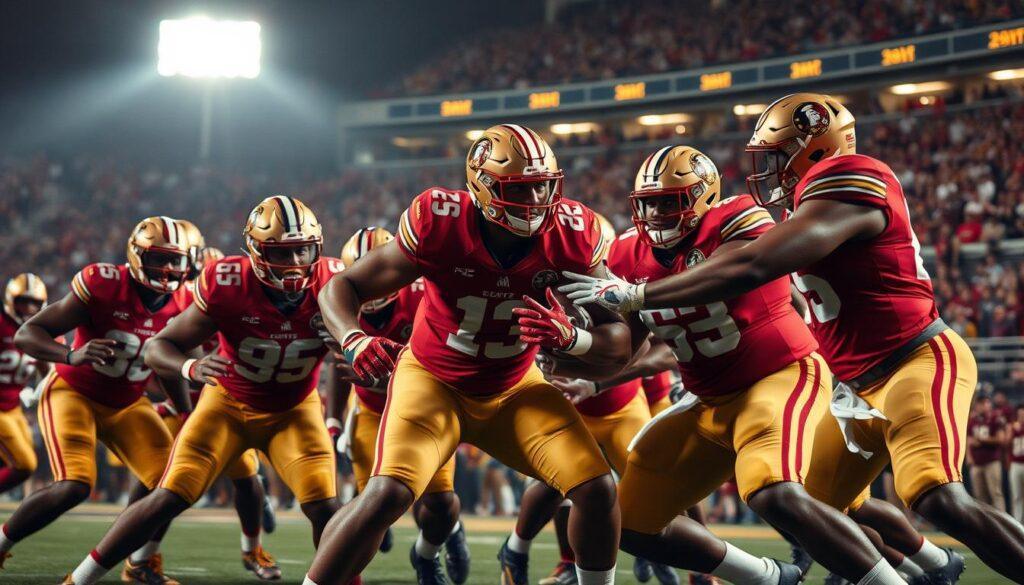
Conversely, the secondary—potentially the best in the ACC on paper—must provide the luxury of time. This unit, a blend of returning starters and savvy transfers, needs to provide sticky, press-man coverage. This gives the defensive line those extra, critical seconds to win their one-on-one battles.
It’s a delicate balance: the coverage must hold just long enough for the pressure to arrive, and the pressure must arrive before the coverage inevitably breaks down. This interdependency is the core of defensive coordinator Adam Fuller’s chess match. Does he stick with the 4-2-5 base to maximize speed and coverage, or adjust the scheme to bolster the run defense, trusting his secondary in more single-high safety looks?
The inexperience at defensive tackle and linebacker makes this a high-stakes calculation.
The chess match is won or lost in the details. The table below breaks down the key components of this defensive synergy:
| Position Group | Key Personnel & Role | 2024 Synergy Outlook |
|---|---|---|
| Defensive End / Edge Rusher | Patrick Payton, Marvin Jones Jr., Sione Lolohea. Must win 1-on-1s if the offense slides protection. | High-upside group that must replace a superstar’s production. Success hinges on their ability to win quickly. |
| Defensive Tackle | Newer, less experienced group. Critical for interior push to flush QBs into edge rushers. | Biggest question mark. Their ability to collapse the pocket up the middle is the X-factor. |
| Linebacker | Must be effective in run support and short-zone coverage to limit “easy” throws for the QB. | Key to stopping the run and disrupting quick-game passing, forcing QBs to hold the ball longer. |
| Cornerbacks | Potentially the ACC’s best secondary. Must excel in press and off-man coverage. | Their ability to play tight, one-on-one coverage is the “safety net” for the pass rush. |
| Safeties | Must be the erasers: cover deep, support the run, and disguise coverages. | Critical for disguising coverages and preventing explosive plays when the blitz is on. |
This synergy is the ultimate test of Fuller’s scheme. If the front four can create pressure with just a four-man rush, it allows for more defenders to drop into coverage, creating a confusing, suffocating defensive look. If the pressure doesn’t get home, the secondary will be on an island—a dangerous place to be in the pass-happy modern game.
The ACC race could very well be decided by this unit’s ability to find its rhythm. If the pass rush and coverage are in sync, this defense won’t just be good; it could be the kind of unit that single-handedly wins games. If they are out of sync, the entire defensive identity could unravel. The margin for error is thin, but the 2024 season will be a masterclass in whether a defense can be more than the sum of its parts.
Offensive Identity: Tempo, RPO, Gap/Zone with New Pieces
Florida State’s offense is like a chemistry experiment. It has a new quarterback and many new players. They aim to create a new way of playing, blending tempo, power, and quick decisions.
Last year’s offense was clear. This year, it’s a mystery. The team has new players at key spots. They need to learn a fast, complex system.
The Tempo Conundrum: Fast, But to What End?
Norvell’s system is fast but needs precision. New quarterback D.J. Uiagalelei, a FSU transfer, must learn this fast pace. His quick thinking is key to the team’s success.
The RPO: The Offense’s Central Nervous System
The RPO is the heart of the offense. It’s not just a trick. The quarterback’s quick read of the defense starts the play. With new players, this system is being updated.
- The Running Back’s Read: The running back must be patient and make one cut, reading the same key as the QB.
- The O-Line’s Dance: They must block like it’s a run, even if the QB pulls the ball. It’s a high-wire act of controlled aggression.
- The Receiver’s Adjustment: New receivers like Malik Benson must run option routes based on coverage, a complex dance of sight and trust.
This isn’t just a play; it’s a high-stakes, real-time chess match where a wrong read by anyone breaks the entire sequence.
The Trenches: The Unseen Battleground
The line’s performance is key. The production replacement on the O-line is the season’s biggest variable. Last year’s unit sometimes struggled to impose its will. The 2024 unit must master both gap and zone schemes.
| Blocking Scheme | Gap (Power) | Zone (Outside Zone) |
|---|---|---|
| Philosophy | Man-on-man, power drive | Collective movement, horizontal stretch |
| Fits RPO? | Harder (commits line to one path) | Better (linemen move in unison) |
| For This O-Line | Tests raw power, riskier for RPO | Relies on cohesion, communication |
The line’s ability to execute both—a power play on 3rd & 1 and a zone stretch on 2nd & 7—dictates the entire playbook’s viability.
The New Weapons: Speed as a System, Not a Gadget
The additions of Malik Benson (WR) and Jaydn Blue (RB) are strategic. They add speed and depth to the offense. Benson’s speed pulls defenses deep, opening up the field for others.
The $64,000 Question: Who Replaces the Swiss Army Knife?
The tight end room is the biggest question. Jaheim Bell was a versatile player. His production replacement, Kyle Morlock, must fill a big role. The tight end is key in the offense, handling blitzes and 3rd & 6 situations.
The 2024 Seminole offense is a high-stakes experiment. It has a new QB, fast players, and a retooled line. But it’s not just about the players. It’s about how they work together, making quick decisions and trusting each other. The production replacement is ready on paper. Now, they must build an identity, one play at a time.
Early Enrollee Acclimation Timeline
Florida State’s new players dive into spring practice like a high-stakes heist movie. They have 15 spring practices, 7-on-7 in the summer, and a short fall camp. This is their chance to go from new to ready for the season.
This is like a heist movie in months. New players must learn the playbook, understand teammates, and execute the season plan. Spring is for learning, summer for team building, and fall for final touches. Every mistake is a step back in the ACC race.
The acclimation process is divided into three intense phases:
| Phase (Timeline) | Primary Focus | Key Activities & Objectives |
|---|---|---|
| Spring Installation (Mar-Apr) | System Immersion & Playbook 101 | 15 spring practices, weight room integration, base offense/defense installation, learning the “why” behind plays. |
| Summer Integration (May-Jul) | Chemistry & Playbook Mastery | Player-led 7-on-7s, playbook recall under pressure, building timing with QBs/WRs, play-call recognition. |
| Fall Camp (Aug) | Full Integration & Depth Chart Battle | Full-pad practices, scrimmages, situational football, special teams prep, and final depth chart battles. |
FSU transfers face a unique challenge. They have college experience but must adapt to a new system and teammates. Their success is key to FSU’s season. If they can’t adjust, the team’s performance will suffer.
Every mistake is critical when time is short. FSU’s success in the ACC race is built in the film room, on the practice field, and in the weight room. FSU transfers and early enrollees are learning a new language under tight deadlines.
Depth Risk: Injury History and Contingency Plans
In college football, a team’s success isn’t just about who starts. It’s also about who can step in when needed. The transfer portal brings new talent, but does it provide enough depth? This is where the real battle is fought.
The tight end room is at risk of a major crisis if a key player gets hurt. Kyle Morlock is a star, but the backup plan is thin. If he’s out, finding a good replacement is a big challenge.
The defensive line faces a similar risk. The second unit is young and inexperienced. If a starter needs a break, the team’s defense could be in trouble. The linebacker corps is also at risk, with a true freshman ready to play in a big game.
The offensive line has a lot of experience, which is a big plus. But, if a key player like Maurice Smith gets hurt, finding a good replacement is critical. The line’s success depends on everyone being healthy.
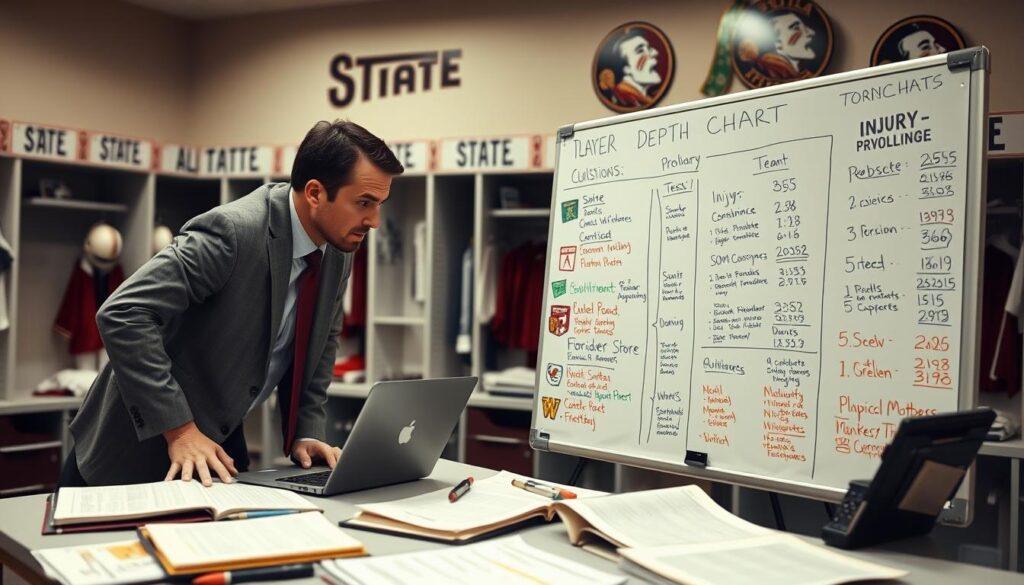
The table below shows the main depth concerns and backup plans. It highlights the thin line between success and failure in college football.
| Position Group | Primary Concern | Contingency Plan | Risk Level |
|---|---|---|---|
| Tight End | Zero proven depth behind starter Kyle Morlock. A high-ankle sprain here is a season-altering event. | Converted WRs, emergency in-line blockers. A true “next man up” simply doesn’t exist with comparable skills. | Critical |
| Defensive Tackle | Young, inexperienced depth behind the starting rotation. A 70-snap game would test the two-deep immediately. | Rely on schematic stunts and creative blitz packages to protect the second unit until they gain experience. | High |
| Linebacker | DJ Lundy’s return is huge, but the unit is one twisted knee from starting a true freshman in a 3rd and 5 situation. | Heavy rotation and simplified assignments for young players. Pray for good health. | Moderate to High |
| Offensive Line (Interior) | Maurice Smith’s health is the linchpin. His veteran presence and calls are irreplaceable. | Multiple players have taken snaps at center in practice. The plan exists, but it’s a step down in cohesion. | Moderate |
The portal’s value goes beyond just signing big names. It’s tested in October, when injuries pile up. Did the team recruit for the long haul, not just for show? The real test is in finding good backups, not just flashy starters. The season’s success may depend on the second-string tight end’s health, not just the first team.
Three Games Where Transfers Matter Most
The portal class isn’t graded on optimism in September. It’s in November, when ACC race hopes are made or broken. September dreams are built on summer hopes, but November legends are made by FSU transfers who shine or fade.
Forget the early-season games against weaker opponents. The true value of a portal haul is seen in tough games. Here, Florida State’s transfer class will face their biggest tests.
The Early-Season Rivalry Crucible
Every season has a rivalry game early on. For FSU transfers, this is their first big test. The atmosphere is intense, like a social media storm.
This game is the first chance to prove worth. The transfer portal gives experience, but tough rivalry games can be tough. A transfer who shines here, like making a key sack, justifies their recruitment. But one who fails becomes a question mark.
The ACC race often starts with a big game. This rivalry game is often it.
The Mid-Season Road Gauntlet
The mid-season road test is about surviving tough games. It’s not just about stars, but also depth. A 6th-year guard or a Power-5 safety can make a big difference.
This game is about endurance. The portal was meant to provide depth for a tough schedule. Can a transfer lineman make a key block in a tough game? It’s about stamina and fit in the scheme.
The Season-Defining Finale
The final game of the season is critical. ACC race hopes often hang in the balance. This is where the “clutch” gene of your transfer class is revealed.
The transfer quarterback, facing a 3rd-and-long in the final two minutes. The receiver, who hasn’t seen a target all half, making a contested catch to move the chains. This is the moment the portal was designed for: acquiring players with the poise for this exact pressure.
These are the plays that decide division titles and bowl destinations. A transfer who makes a play here justifies their entire recruitment and validates the portal strategy. One who shrinks from the moment can define a season’s narrative. The portal is a high-stakes gamble, and this game is the final reveal of the hand.
| Crucible Game | Transfer Impact Test | ACC Race Implications |
|---|---|---|
| Early Rivalry Test | First true test of composure for new transfers in hostile territory. Can the new edge rusher win a critical 3rd down? Can the new CB handle the #1 WR? | Early conference loss can derail ACC race hopes before they begin. A win builds critical momentum. |
| Mid-Season Road Test | Depth and stamina test. Do the portal’s role players hold up? Does the 2nd-team DT from the portal provide quality snaps to keep the starters fresh? | This is the “body blow” game. Survive with a win, and you’re a contender. Lose, and the ACC race becomes a steep climb. |
| Season Finale Rivalry | The ultimate pressure cooker. Transfer QBs, WRs, and pass rushers are brought in for these moments. Do they deliver when the season is on the line? | Often a de-facto play-in game for the ACC Championship. The portal class’s entire value is crystallized in this one game. |
The portal strategy is a high-wire act. You can recruit talented players, but if they can’t perform in key games, the class fails. The FSU transfers will be judged by their November performances, not just their press conference quotes. The portal giveth, but November taketh away.
ACC Context: How FSU Stacks Up Post-Portal
Forget preseason polls and hot-take rankings. College football is now a year-round, high-stakes game. Florida State is reloading for a title, but rivals are also making big moves. The real question is how much better everyone else got.
The transfer portal has made college football more equal. It’s not just about recruiting top 18-year-olds. It’s about filling roster holes with veterans. FSU has built a strong secondary, but they can’t ignore the competition.
How do the Seminoles fare in this new world? The portal has turned college football into a chess match. FSU’s secondary is strong, but the real battles are in the trenches. Can they beat Clemson’s defensive line and Miami’s new talent?
Let’s look at the competition. A recent analysis of the ACC’s portal shows a changed league. Clemson focuses on development, while Miami is aggressive in recruiting. FSU’s value is tied to what Clemson, Miami, and UNC do.
Here’s a snapshot of the arms race for key positions:
| Team | Key Portal Focus | Notable Portal Addition | Critical Question |
|---|---|---|---|
| Florida State | Secondary, Playmakers | Cornerback, Defensive Line | Can the O-line portal adds solidify the trenches? |
| Clemson | Defensive Front, Veteran Leadership | Defensive Tackle, Edge Rusher | Has their “developmental” model kept pace with the portal era? |
| Miami | Quarterback, Offensive Skill | Veteran QB, Dynamic WR | Can they turn portal talent into immediate, consistent wins? |
Winning the portal is key, but it’s not the only factor. FSU’s success is about more than just replacing players. The ACC race will show who built the best roster. It’s not just about coaching on game day; it’s about who won the offseason. FSU’s secondary is elite, but the real battle is in the trenches and on the recruiting trail.
Portal Class Grade with Rationale
So, what’s the final grade for Florida State’s portal class? It’s not about a five-star composite score. It’s about how well they built their roster. The Seminoles didn’t just sign players; they signed specific solutions.
They targeted and landed speed to stretch the field, power to set the edge, and a quarterback who fits the system. This was a targeted, surgical operation.
They turned glaring needs into strengths. The FSU transfers were chosen for their fit, not just their stars. They found the vertical speed and a more dynamic pass rush needed.
These weren’t random acquisitions; they were precise, system-specific fixes.
Yet, the grade isn’t a perfect A+. The lingering questions at tight end and defensive tackle depth are real. In a portal class built on precision, those are the missing pieces that keep the grade from being perfect.
Final grade: A-. The rationale is simple. The FSU transfers directly and aggressively addressed the roster’s most critical flaws. This wasn’t just a reload; it was a strategic, high-upside retool with the ACC race in mind. The portal moves weren’t just about adding talent, but about constructing a team that can win now.