Let’s dive into one of baseball’s most unlikely stories. The Miami (née Florida) Marlins entered the league and won it all in 1997. Then, they threw away the winning formula.
They sold off their stars and faced financial troubles. It was a classic boom-and-bust cycle. Yet, six years later, they were champions again. This is more than a sports story; it’s a lesson in bouncing back.
The Marlins are the only modern team to win two World Series without ever winning a division title. How did they do it, twice? It’s a question that has puzzled fans.
This isn’t about dynasties. It’s the tale of the ultimate underdog. In October, it’s not about who you are. It’s about the magic you bring.
Expansion to Champions: timeline snapshot
The Miami Marlins story is like a heist movie. Baseball arrived in South Florida in 1993. On that spring day, the Marlins played their first game at Joe Robbie Stadium, in front of 42,334 fans.
Charlie Hough threw the first pitch, a knuckleball for a strike. The Marlins won 6-3 against the Los Angeles Dodgers. Jeff Conine, who became “Mr. Marlin,” went 4-for-4 with two runs scored. It was a beautiful start.
Most teams start with years of losing, then slowly build. But the Marlins didn’t follow this path. They became champions in just their fifth season, defying all expectations.
They didn’t grow organically. Instead, they signed many free agents. Owner Wayne Huizenga and General Manager Dave Dombrowski focused on quick, strategic moves. They built a strong team fast.
This team was a mix of experienced players and new stars. Gary Sheffield, Kevin Brown, and Moisés Alou were among them. Their early years were marked by quick success, not slow growth.
| Year | Typical Expansion Team Phase | 1990s Florida Marlins |
|---|---|---|
| Year 1 (1993) | Building fanbase, developing identity, high losses. | Win inaugural game. Jeff Conine emerges as a face of the franchise. |
| Years 2-4 | Accumulating top draft picks, trading veterans for prospects. | Aggressive free-agent signings and trades. Core of a contender is assembled via market, not just draft. |
| Year 5 (1997) | Hope for a .500 season; playoffs are a distant dream. | Win the World Series. Defeat the Cleveland Indians in a dramatic seven-game series. |
| Primary Strategy | Long-term player development and patience. | Immediate contention through financial investment and strategic veteran acquisitions. |
This fast path was not just quick; it was a bold statement against traditional baseball. The fifth-season championship is a remarkable achievement. It showed the Marlins were ready to do things their own way, for better or worse. The 1993 knuckleball was a sign of their unpredictable, effective approach.
1997 Run: Key trades, Rentería’s moment, staff depth
The 1997 World Series is remembered for more than just home runs. It’s about a young player’s chopper that became legendary.
General Manager Dave Dombrowski was like a curator, not a farmer. He built a team of stars for one great season. The team had talent from everywhere.
He made smart trades for Gary Sheffield and Robb Nen. Free agency brought Kevin Brown, Al Leiter, and Moises Alou. Latin American scouting found Edgar Rentería and Liván Hernández. The draft gave them Charles Johnson.
The team faced its biggest test in Game 7 against the Cleveland Indians. The game was intense, with the score tied in the 11th inning. Edgar Rentería was up.
Rentería’s swing was quiet, but the ball found its way to center field. Craig Counsell scored, and the Marlins won their first World Series title.
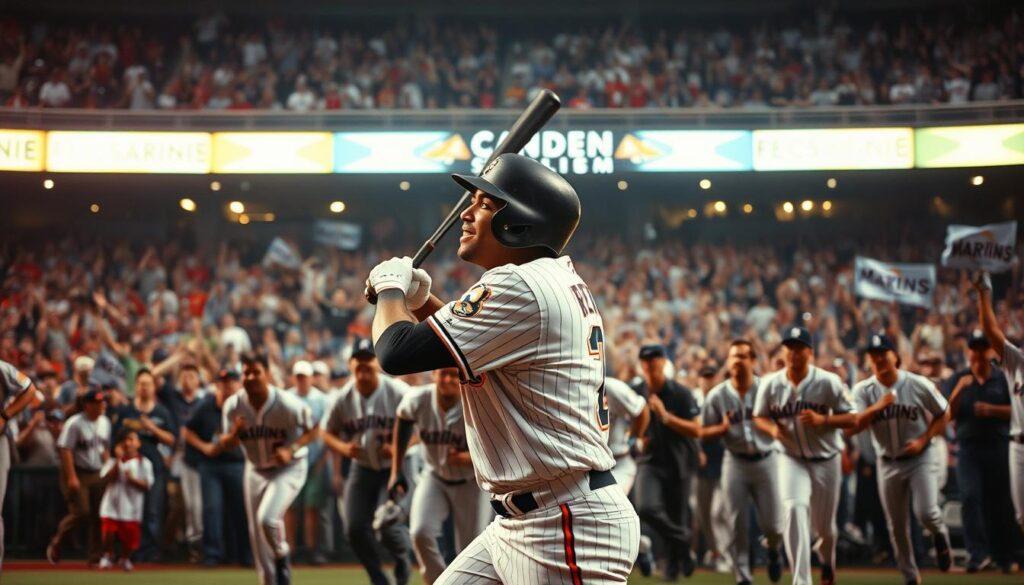
That moment, the perfect squib, showed the team’s spirit. They didn’t just win; they outsmarted and outplayed their opponents. The staff depth was staggering.
The 1997 Marlins showed that a well-built team can win in a short series. Edgar Rentería’s single was the final touch on their journey.
2003 Run: Youth movement, Beckett’s masterpiece
The 2003 Marlins’ journey to victory was unplanned. It was a team of young players who surprised everyone. They didn’t follow the usual path to success.
By mid-May, things looked bleak. The team started 16-22, leading to Jeff Torborg’s firing. Larry Beinfest then brought in Jack McKeon, a 72-year-old manager. McKeon’s first move was to let the young players shine.
The team was full of talent. Josh Beckett, Miguel Cabrera, and Dontrelle Willis were just starting their careers. They were backed by Pudge Rodriguez, a seasoned player. This team was like an indie band that became a hit unexpectedly.
The regular season was a transformation. The playoffs were their big moment. They beat the Giants and the Cubs, making history.
Then, they faced the New York Yankees in the 2003 World Series. It was a matchup that seemed one-sided. But Josh Beckett had other plans.
In Game 6, Beckett pitched a complete-game shutout. He struck out nine and walked two. It was a performance that stunned everyone.
Beckett’s game was the first complete-game shutout to win a World Series in 12 years. He didn’t just beat the Yankees; he silenced them. It was a night of history.
The story of the 2003 World Series was unique. It was a team of young players led by a 72-year-old manager. They proved that youth and determination can overcome all odds.
Looking back, the 2003 Marlins’ run was a special moment. It showed that chemistry and talent can beat big budgets. Josh Beckett became a legend that night. The real magic was in the team’s belief in themselves.
Clubhouse Stories and Fan Lore
Baseball statistics are like the skeleton of history. But clubhouse stories are its heart, beating with wild rhythms. The Marlins’ history is full of these tales, where data meets mythology.
Alex Gonzalez’s walk-off homer in the 2003 World Series is legendary. It was a game-changer, showing the Marlins’ determination. This moment is etched in fans’ memories, a story of triumph.
Pudge Rodriguez’s play in the 2003 NLDS is unforgettable. He caught a ball while being hit by a runner, showing his will to win. This act of bravery is a testament to the team’s spirit.
Miguel Cabrera’s rookie season was marked by his fearless play. He hit a game-winning RBI single, showing his instinct and skill. This moment highlights the impact of young players.
The 2003 NLCS was a turning point for the Marlins. They rallied in Game 6, showing their team effort. This rally was a testament to their youth and determination.
The Marlins have a rich history of no-hitters. These games showcase the team’s pitching talent and individual brilliance. Each no-hitter is a unique story in the fans’ hearts.
| Moment | Series | Hero | Why It’s Legendary |
|---|---|---|---|
| Walk-off HR, 12th inning | 2003 World Series, Game 4 | Alex Gonzalez | An unlikely power source delivers ultimate clutch hit. |
| Plate Block Collision | 2003 NLDS, Game 4 | Ivan “Pudge” Rodriguez | Pure will and defense personified in one play. |
| Intentional Ball RBI Single | 2003 Regular Season | Miguel Cabrera (Rookie) | Audacious improvisation that broke “unwritten rules”. |
| 8th Inning Rally | 2003 NLCS, Game 6 | Team Offense | A collective, season-saving burst of momentum. |
| No-Hitter Tradition | Various Seasons (5 total) | Multiple Pitchers | Consistent pitching excellence creating historic nights. |
These stories are the Marlins’ lifeblood. They teach us that the team’s magic came from its young players. These players played with joy and fearlessness, creating unforgettable moments.
This lore proves that the Marlins’ history is real and as amazing as fans remember. In a sport focused on numbers, these human moments are the true championships.
Strategic Threads: Pitching development and defense
The ’97 and ’03 Marlins champions shared a common thread. It wasn’t about hitting home runs. Their secret was a deep love for top-notch pitching and solid defense.
The ’97 team bought stars like Kevin Brown and Al Leiter. This was a costly but effective strategy.
The ’03 team took a different approach. They focused on building for the future. They found gems like Josh Beckett through scouting and trades.
Beinfest’s team was like a Wall Street hedge fund. They found hidden gems and made smart trades:
- Dontrelle Willis for Antonio Alfonseca and Matt Clement.
- Brad Penny for Matt Mantei.
- Derrek Lee for Kevin Brown (turning one ace into a future cornerstone).
- Mike Lowell for three minor leaguers.
They bet on stuff and glove, not just stats. This approach gave them a lasting edge.
Defense was key in the postseason. The ’97 team had Luis Castillo and Edgar Rentería as their middle infield duo.
The ’03 team followed with Mike Lowell and Adrian Gonzalez. This wasn’t “Moneyball.” It was “Stuff-and-Glove-ball.”
A great pitcher can make up for weak offense. A solid defender can save a season with one play. Their strategy was brilliant, but their roster wasn’t sustainable.
Advanced Numbers: Postseason WPA and clutch hits
The Marlins’ postseason WPA charts are like EKG readings during a heart attack. Win Probability Added shows how much a play changes the win odds. Most teams have smooth graphs, but the 1997 and 2003 Marlins built mountains.
Wild Card teams are not weak champions. Six have won the World Series, with the Marlins and 2002 Angels among them. These teams have some of the greatest moments in the Wild Card era.
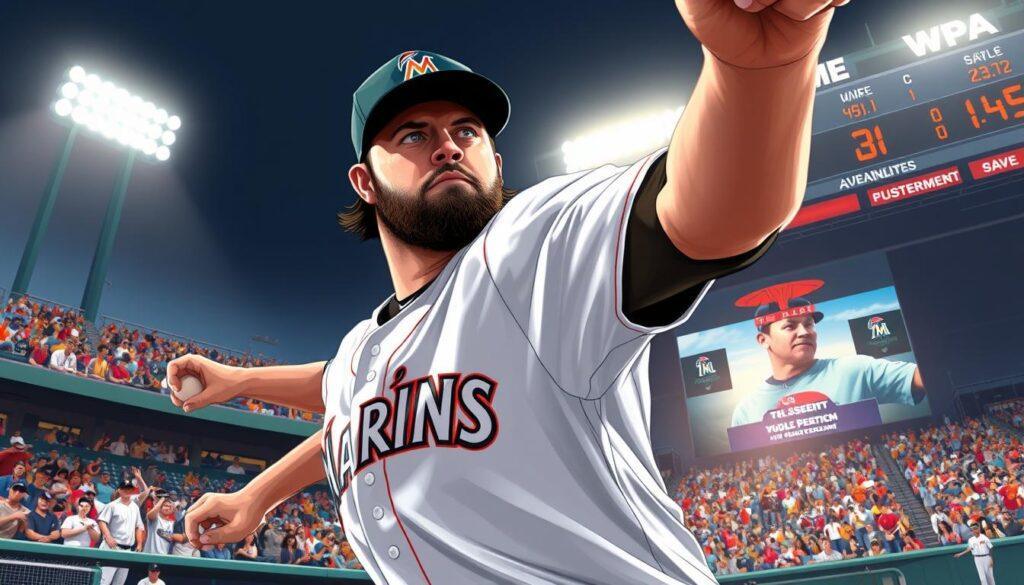
Josh Beckett‘s Game 6 performance in 2003 is unmatched. He took over the game, making the Yankees’ win odds drop to zero. His performance is a statistical masterpiece.
Beckett’s heroics were just the start. Edgar Renteria’s Series-winning single and Alex Gonzalez’s walk-off homer are key. Miguel Cabrera’s hits were vital too. Together, they created a mountain range on the graph.
The Marlins played calmly under pressure. While others faltered, they excelled. Josh Beckett‘s complete-game shutout was the ultimate proof of their clutch ability.
The Marlins were good in the regular season but great in the postseason. Their run differential and win totals were solid. But their October WPA showed they were built for the moment.
For stat-heads, the Marlins’ wins are not flukes. They prove that in October, the clutchest team can beat the “best.” The Marlins didn’t just play the game; they changed the odds.
After the Parades: Rebuild cycles and lessons
The championship hangover in South Florida wasn’t from champagne; it was from the fire sale that followed. While other teams celebrated their titles, the Marlins knew how to strategically retreat. Their unique curse wasn’t failure—it was the mandatory purge after the party.
The 1997 dismantling is sports infamy. By Christmas Day 1998, the core team was gone. Only a few, like Charles Johnson and Cliff Floyd, stayed. The rest were traded for prospects, leaving fans feeling betrayed.
The 2003 World Series champions avoided an immediate bloodletting, but the pattern was the same. Stars like Miguel Cabrera, Dontrelle Willis, and Josh Beckett were traded. This boom-bust cycle became the franchise’s DNA. So, what’s the lesson here?
In a market without a massive, perpetual TV revenue stream, a championship is a depreciating asset. The Marlins’ front office cashed in at peak value. It created a cynical, yet efficient model: go all-in, win, then trade stars to fuel the next cycle.
For fans, it was emotionally exhausting. It showed that their joy had a price tag. Every parade route seemed to lead directly to the trade block. This constant churn made building a lasting connection nearly impossible.
Yet, their two titles are even more miraculous. They were pulled from the jaws of systemic disadvantage. The Marlins didn’t just beat other teams; they beat the economic game itself, if only for a fleeting moment. The legacy isn’t just in the trophies, but in the stark, unsentimental strategy that surrounded them.
Legacy on today’s Marlins and prospects to watch
The fifth no-hitter in Florida Marlins history was a surprise. Henderson Alvarez blanked the Detroit Tigers in 2013. It was a brilliant moment in a long, often cloudy story.
The modern Miami Marlins are a mix of underdog and stepping stone. They can shock the world but often lose their stars. This cycle has been their story for years.
The legacy of no-hitters by Aníbal Sánchez and Alvarez is strong. It also remembers Josh Beckett and Dontrelle Willis. Their history is one of flashes of brilliance and long periods of average play.
Today, the Marlins aim to build a lasting team. Can they keep their stars? For fans, this idea is as rare as snow in Miami.
Every new player is compared to past champions. It’s not just about talent. It’s about becoming the cornerstone that breaks the cycle, much like the legendary moments recorded in Alabama college football history, where individual stars and team leaders shaped dynasties and left lasting legacies.
The Marlins’ history shows anything can happen. Two wild cards won two titles. But it also teaches that success is fleeting. The future is always just one pitch away.